
Aftermarket Alternators for BMW Airhead motorcycles.
Installation, Capability, Performance.
https://bmwmotorcycletech.info/AftrMrktAlt.htm
15-C
© Copyright 2021, R. Fleischer
SUGGESTED: Read 15-A and 15-B, first!!!
15-A: https://bmwmotorcycletech.info/altcapability.htm
15-B: https://bmwmotorcycletech.info/trbleshootALT.htm
INTRODUCTION:
There is nothing wrong with the design of the BMW Airhead motorcycle’s stock Bosch alternators. Like most anything they will age, and/or they may be abused, they may fail, although not in excessive numbers. They are often never maintained until there is a failure. Wattage output was adequate for most riders when the motorcycles were originally sold by BMW. The modest electric output may be of concern if you have lots of accessories ….such as heated clothing, heated grips, extra headlights, etc. I am not for or against aftermarket alternators. I am reporting only facts and testing information and conclusions. You may well do fine with the stock system. But, if you have special needs, such as large city stop and go commuting; or need more watts ….perhaps you are approaching the stock alternator limits (which decreases reliability) ….there is plenty of information in this article. The /5 Airheads had a 180 watt Bosch alternator with a stator diameter of 105 mm where it fit into the engine case. It can be upgraded easily by using an EARLY /6 alternator stator (if it is 105 mm, and NOT 107 mm), and any pre-1985 (approx.) rotor (last rotor version of 2.8 ohms is not recommended) and any /6 or later diode board. Reliability can be improved for ANY Airhead alternator, stock or aftermarket, and this includes a stock /5 model, or a /5 upgraded to the 280 watt 105 mm Bosch; OR EVEN AN AFTERMARKET ALTERNATOR; ….by using the later, better ventilated, front metal engine cover. If you have an RS or RT model, and the front fiber-glass-like outer cover is NOT louvred, even more reliability will be had by changing to the louvred type, or putting attractive holes into yours.
Refer to: https://bmwmotorcycletech.info/altcapability.htm
This article includes/provides information that is far beyond what advertisements for various alternators provide. Charging a battery in a vehicle like your Airhead is NOT as simple as you may think; nor, is interpreting the alternator ratings, typically simply shown as wattage. This article presents a huge amount of information; and, also presents information that helps you select an aftermarket alternator. I suggest you read this article completely through to get an over-view; then refer back to the areas you are interested in. If confused, please inquire on Snowbum’s favorite forum for inquiries; an E-mailing LIST, the Airheads List, as hosted by Micapeak.com. Input will help others, rather than my answering individual inquiries, which are discouraged.
https://lists.micapeak.com/mailman/listinfo/airheads
DISCUSSION. Much of this is pertinent to ALL charging systems:
Measuring or specifying generator (alternator) output in watts is not as simple as it may seem. The simple part is that watts is equal to voltage multiplied by amperes. Yes, the output of an alternator can be measured in amperes and voltage, multiplying those together would gives watts; but, there are complications. For the purposes of this Discussion, a lead-acid type battery is assumed.
The output of the alternator system should be AT LEAST specified and measured at a practical/usable voltage. It is wrong to use alternator sales brochures in which voltage, perhaps not even stated, is not high enough to keep the battery charged; or, at least close to fully charged, because it is possible for the system output voltage to sag from a large load (big headlamp, driving lights, heated clothing, poor battery, etc). If the output voltage is too low to keep the battery fully charged; yet the current availability was high, it is possible for false wattage advertising. What is important is the real output with a “reasonable & usable” charging voltage at the battery, that keeps the battery charged enough to have good battery life & maintain close to battery rated ampere-hours capacity …..and be able to restart the bike many times reliably, etc. You want reasonably fast recharging after such as starting, or being at a traffic signal for awhile. The “reasonable & usable” battery voltage can be argued about. A battery is considered to be fully charged at a RESTING (resting means after standing for some time…not seconds of time) voltage of 12.5 to 12.7; and, will pass a formal Load Test. A battery at 12.4 volts or below is NOT fully charged, and is deteriorating, the lower, the faster the deterioration. A battery with such a voltage is also NOT going to deliver its rated performance. The rider needs to know if the alternator will or will not produce a full charge during extended cruising; as well as knowing what the performance will be in stop and go traffic. The system should be capable of handling all the electrical items likely to be in use at the same time.
Considerations:
If the voltage is too high, the battery could deteriorate from too much voltage being applied, which also means too much current, which means wattage (heat) being produced by excessive electricity flowing into the battery. The battery could overheat & warp; or use water too fast, or if a sealed type it might have enough internal pressure to open the safety valve (VRLA types and other sealed batteries). Excessive voltage output which can greatly reduce battery life has NOT been any problem in any of the systems I tested.
The battery should recharge quickly after starting the bike, and, reasonably from long periods of waiting at stop lights and then riding off. A consideration seldom considered is if the alternator capability is quite high the excessive charging current could damage the battery. Most modern batteries are capable of withstanding quite large charging currents for short periods of time, so are not damaged, or not damaged excessively, by use of powerful alternators.
You need considerably higher charging voltage than 12.7, due to inefficiencies in battery chemistry, to allow the battery to reach full charge in a reasonable amount of time. This can become critical when doing stop and go riding in city traffic.
When you stop where you are going, be it work or home or other place, you want the battery to be fully charged …or nearly (or, reasonable…your choice of words here). If you ride to work in stop and go city traffic, and the battery does not get over perhaps 12.3 as measured a few minutes to an hour or so after you park the bike for the day ….then the battery is not fully charged, and IS deteriorating. It may start the bike. It may fully charge on the way home if traffic is lighter, but SOME damage WAS done. If your battery is poor, and here I mean the internal resistance has increased a fair amount, then the battery might still start your bike, and might still show a full charge as far as VOLTAGE is concerned (during charging) ….but the battery terminal voltage will SAG during testing, often quite a bit, and measurements for alternator output/performance will be somewhat tricky to accomplish accurately.
The INITIAL testing on the Omega 450 and 600 were done on the SAME bike, with the SAME “poor” battery, which happened to be the popular Odyssey type. LATER, a brand-new Panasonic battery was used, and the tested alternator performance is ALSO noted in this article.
There are three basic reasons for an aftermarket system; (1) you need more usable watts; & (2) you believe a new system will give more reliability; & (3) you’d like the additional watts to be available at idle rpm, or, not much above, which is quite helpful for stop and go riding in big city traffic. Idle rpm or slightly above idle rpm output, should be sufficient for normal use, as this is one of the complaints about the stock system, in stop and go commuting use.
The idle rpm of Airhead motorcycles should not be set below 900 rpm, no matter what you read elsewhere’s, and no matter what alternator, stock or otherwise. 900 is OK for early heavy flywheel models, but I recommend a target of 1000 to 1050 rpm for idle rpm after a full engine warm-up (10 miles perhaps) at the normal altitude and temperature you ride in, any model. As much as 1500 is OK. These figures were selected by me for a variety of factors, including carburetor performance & synchronization, and good timing chain compartment lubrication ….and potential for some alternators to provide actual usable output at 1200 RPM under some circumstances. Snowbum personally uses a fully warmed up engine idle rpm of 1050.
There is an effect I will call hysteresis. Due to untested factors, but believed to be the minimal but notable (?) magnetic memory of the rotor, TOGETHER with the wound wire type of rotor’s current turn-on characteristics due to the voltage regulator (in conjunction with the GEN lamp current-passing ability), you MAY find, that to INITIATE usable current from the alternator, you need a certain RPM. Once that RPM or higher is obtained, you will get some sort of output from the alternator if you lower RPM somewhat BELOW what was needed originally. This is not a necessarily totally and always repeatable situation, depending on how low the RPM might reach now and then during the ride ….but the effect is notable. The hysteresis of the 600 watt alternator from Emerald Island (Omega) was fairly pronounced using the various Omega items. This characteristic helps this alternator operate rather decently in the RPM area usually seen only with large permanent magnet alternators.
The charging characteristics of batteries of different types varies. For MOST types of lead-acid batteries, if one applies a voltage of about 12.8, constantly, eventually, …and this could take a LONG TIME, ….the battery will reach approximately full charge and then require very little current, from the charger or system, to maintain that voltage. UNfortunately, that voltage is considerably too low, and hence the charging is very considerably too slow, for practical on-road recharging. The battery needs a much higher APPLIED voltage to reasonably quickly re-charge. Some battery types, notably the AGM/VRLA types, are quicker to convert chemically to a full charge, but still need much more than 12.8 volts of alternator output.
Batteries vary rather widely as to the current needed from the alternator to maintain a specific voltage. Generally a typical ‘flooded’ type of battery of motorcycle size (I will use the larger motorcycle size, about 28AH, as illustration), will need about 1 to 3 amperes to maintain about 14.1 volts AT the battery TERMINALS. Some Gel and AGM type batteries are quite different. The 1 to 3 amperes has NOTHING to do with what the rest of the motorcycle will require for ignition, lights, etc.
1 to 3 amperes at 14.1 volts means that just maintaining the battery AFTER it reaches full charge will require 14 to 42 watts from the alternator! When totalling up your system drains, be sure to add those maintenance watts!
A battery requires more voltage to re-charge at lower temperatures. With the voltage regulator at room temperature, the motorcycle’s alternator system will try to keep the battery at a high floating charge level, perhaps around 14.2 volts (this could be 13.7-14.7, depending on VR and a few other things), when the rpm is high enough & assuming there is enough alternator output capability. As temperature drops, the VR output should increase SLIGHTLY, and vice-versa. A tenth to three tenths of a volt is typical, with maybe another tenth if the temperature is below freezing. BMW’s original VR settings for the stock bikes was actually ~13.8 volts. I have always felt that BMW was WRONG in selecting 13.8 volts but I understoodd why; which has to do with keeping water use in the battery at a low usage rate. The Authorities (Police) VR is set to approximately 14.4 depending somewhat on temperature. Most voltage regulators have a voltage versus temperature effect purposely built-in. This is because the voltage needed to maintain any given charge percentage on a lead-acid battery will vary with temperature, AND, the chemical conversion works faster with a slightly higher charging supply voltage when the battery is COLD. The COLDER the battery, the more voltage is needed from the system. The voltage regulator ideally is mounted in the same airflow as the battery. Generally, there is only a few tenths of a volt compensation built into the VR, from perhaps 120°F down to perhaps 20°F…the typical range of temperatures seen by the battery and VR. Motorcyclists may ride where battery temperature will exceed 140°F (typically from engine heat blown over the battery). Some ride when the weather is below freezing. As the battery temperature falls towards freezing and below, the battery has a much more difficult time (it is, at its core, a chemical reaction device) producing the current needed to start the engine. The engine has higher friction due to cold/thick oil and decreased clearances from metal shrinkage. THUS the starter motor is going to require a LOT more battery current. The chemical conversion in the battery to produce electricity ALSO gets more sluggish, and this is not only in battery delivery of electricity, but in re-charging, hence the higher charging voltages. In cold weather, everything is much harder on the electrical system.
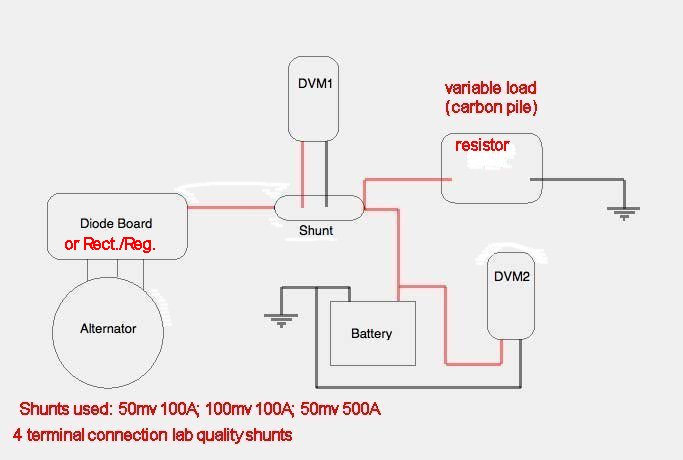
Schematic diagram of our test circuit that was used for all alternator testing; with few differences. Note that wires were of very large gauge, and connections also large, to avoid errors. As noted, the shunt used was a laboratory type, with 4 terminals to eliminate DVM1 errors, which is why the wiring for DVM1 is shown inboard of the ends of the shunt….as that is the shunt’s design.
The STOCK Bosch Alternators:
BMW has used several versions of the ‘stock’ Bosch alternator in its various Airhead motorcycles. The highest output was 280 watts rated, used in the /6 and well into the eighties. The R90S alternator was rated at 238 watts. The last of the Airheads also had 238 (published as 240) but began charging somewhat lower in rpm than earlier models (except ~same as certain specific early Authorities models). The following table shows TRUE ACTUAL USABLE OUTPUT of the stock 280 watt Bosch alternator, using 3.7 or 2.8 ohm later model rotors, early eighties stator; known perfect connections, wiring, battery, switch, etc. You REALLY CAN expect to get VERY close to the rated output from Bosch Alternators, if your system has good solid connections, etc. Alternator delivery of rated output is NOT necessarily so with some aftermarket ones. You will be able to see that in this article.
| RPM | Output Amperes | NOTES |
| 1050 | 2.5 | |
| 1550 | 10.0 | Approximately the point of equilibrium with the stock drain of lights and ignition |
| 2100 | 15.0 | 5+ amperes is available for charging after considering the ignition, basic lamps, etc. |
| 2850 | 20.0 | MAXIMUM available. Battery at 13.5 v, and rising. This is 270 watts. Very slightly more will be available as the voltage rises more. |
| Only 2100 RPM is needed, constantly, but that is lower than you should cruise at. | watts = voltage multiplied by amperes
13.5 volts is enough to maintain 100% of battery charge and a reasonable recharging rate. 14.2 is better. |
The stock alternator produces very close to what Bosch specified. The voltage is a decent value, & above the minimum needed by the battery to maintain a FULL CHARGE, even at maximum output. Note the 1550 RPM equilibrium point. This means that the battery will, if already fully charged, not be discharging at a constant 1550 RPM. You would…and should…. never be riding in such a low rpm situation, except as you are accelerating from idle rpm, even then not at too much throttle.
The first generation “400” Omega Alternator, as sold by Motorrad Elektrik:
There are two sources (in the USA) for the GENUINE “Omega” Alternators, mfr by Jeff Lee of Emerald Island. These are products of high quality. Those sources are:
Ted Porter’s Beemershop: http://beemershop.com
Motorrad Elektrik: www.motoelekt.com
Tests on the original 400 watt, 450, and 600 Omega were not as extensively done as on the EnDuraLast…no temperature, oscilloscope, stress gauges, hot/cold differences, etc. What follows for the 400 watt early Omega is probably what YOU could actually expect of it. The new 450 and 600 watt Omega’s are in the next following section.
Testing was with a known accurate ammeter setup with short heavy gauge leads, connected in series with the Omega diode board output. The good battery was drained somewhat to begin with (on purpose); and, a digital voltmeter was placed across the battery terminals. Readings were taken well before the battery was charged, with heated grips, accessory lights, and headlight… all turned on. Readings were repeated with lights off, & also with the battery fully charged. The “set point” of the VR appeared to be close to 13.8 volts. I consider that somewhat too low for best battery life and system performance, but it does extend intervals between adding water on flooded type batteries.
OMEGA “400” alternator:
NOTE: Battery was loaded with a resistance box (carbon pile type) to obtain those ‘less than fully charged’ voltages. If not so loaded, the alternator would show usable output at 1550. The first chart below is a summary, & where you see two instances of the same RPM with lower/higher voltage, that was due to battery charge condition at the instant of measurement, & small deviations from expectations, due to, I think, heating, carbon pile setting, etc. That information is more useful to nerdy types like your Author, here. This effect is much more
| RPM | Voltage at battery | Output in amperes | Watts |
| 1550 | 11.70 | 2 | 23.4 |
| 1700 | 12.5 | 5 | 62.5 |
| 1750 tst 1 | 11.83 | 8 | 95.6 |
| 1750 tst 2 | 12.5 | 5 | 62.5 |
| 2200 tst 2 | 12.8 | 12.5 | 160 |
| 4000 tst 1 | 12.64 | 28 | 354 |
| 4000 tst 2 | 13.5 | 20 | 270 |
| 5000 | 13.2 | 31.5 | 415.8 |
| > 5000, no improvement; |
You would need ~2400 rpm to enable the output of the stock 280 Bosch at 2100. THUS, you can rightly assume that this alternator is not any better for constant stop and go in town, unless you have a bit of distance between stops….wild guess would be a half mile or more. But, this alternator DOES produce considerably more total wattage than the stock 280 Bosch, out on the road.
NOTE CAREFULLY, the two 1750 & the two 4000 rpm tests. Note how the wattage varies with the voltage. I specifically loaded the system in order to enable these readings. What especially interested me is that at 1750 rpm, a heavy load that dragged the system to 12.5 volts produced 95.6 watts, but the voltage was too low to fully charge the battery, although safe enough. Compare carefully to the two 4000 rpm tests. You can see that the battery would be MARGINALLY CHARGED at 4000 rpm if 28 amperes of load was used. This resulted in 354 watts.
If the load was DEcreased, the voltage rose to 13.5 volts. That is STILL not enough floating voltage (IMO)…I’d prefer to see 14 volts or even a bit more; but it IS OK. Increasing rpm beyond 5000 did not yield increased output. If using this alternator, performance WILL BE enhanced by using a voltage regulator set point of 14.1 to 14.5 volts.
To be FAIR about all these things, note that this alternator WILL keep the battery charged more than enough to enable you to HAVE AND USE WELL OVER the maximum wattage that the stock Bosch 280 can produce.
Output might be better for the battery if the VR was set higher, see above note. The voltage regulator was NOT the adjustable type on this tested bike. The battery was also not new. The ammeter & its leads & connections add a small series resistance; this would have the effect of moving the output higher up in rpm (although slight and more at highest outputs). This also applies to the Bosch and EnDuraLast during tests.
It is interesting to compare figures with the stock Bosch system. While it is possible that there are some things that I did not get into in any in-depth discussion, especially that the stock Bosch-equipped bike I tested had perfect electrical connections, etc…..still, the Omega output was low at low rpm, but it rapidly overcame the stock system as rpm into the cruising area was attained.
It is important for those with considerable need for more wattage, to understand that the output of THIS Omega, the 400, is ultimately HIGHER than the EnDuraLast…..but that the EnDuraLast has much higher output at truly low rpm, thusly, is PROBABLY better for COMMUTERS, especially if their electrical needs are modest. NOTE, again, I am speaking of THIS PARTICULAR Omega system, the 400. Things change for the larger, later, Omega alternators.
The weight of the Omega is nearly identical with the stock Bosch; differences are so small as to be of no concern.
Omega 450 watt and 600 watt alternators (400 looks almost identical to the 450):
NOTE: Scot Marburger has written up what and how we, together, did the testing, etc., in April, 2016. He will have further information in his article, eventually. We finished the final testing June 12, 2016. You may be interested in reading his article…and it has a lot more information about the installation, why’s, how’s, etc….and…more photos!
http://www.gunsmoke.com/motorcycling/r100rt/alternator/index.html
NOTE the MUCH increased (so it appears) number of magnetic poles on the 600W Omega (Emerald Island Co.) stator, in the below photo. Also note the LAST VERSION of the stock Bosch alternator stator in the second photo. ALSO note the big difference in how the windings were done, between the 400 and 450 and Bosch (as a group) and the 600. The 600 does everything possible to have a larger rotor and stator, that will still fit into the motorcycle without machining being necessary to the motorcycle case.
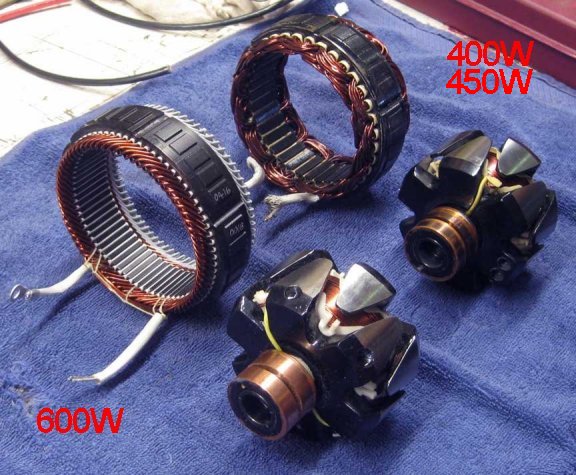
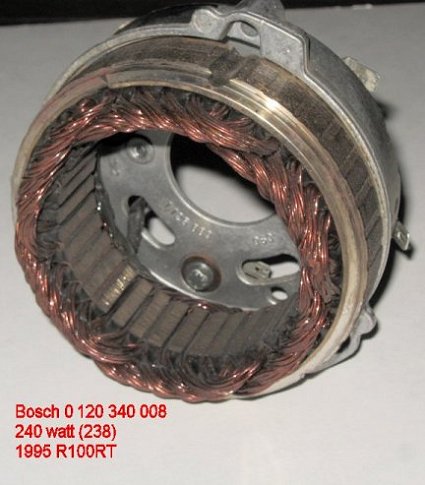
NOTE: If your battery is poor, and here I mean it’s internal resistance has increased a fair amount, and possibly a formal Load Test would show so-so performance….then the battery might still start your bike, and might still show a full charge as far as VOLTAGE is concerned (during charging)….but the battery terminal voltage will SAG, often quite a bit, and measurements for alternator output/performance will be TRICKY to accomplish accurately. The testing on the Omega 450 and 600 were done on the SAME bike, with the SAME poor battery, which happened to be the popular Odyssey battery.
Testing was done with a laboratory grade 50 Mv 500A commercial shunt, with a quality digital meter connected to it for ampere output testing. The shunt was connected in the diode board output lead, so measurements were of ACTUAL alternator output ONLY. A digital meter was connected across the battery terminals. A carbon-pile type adjustable load resistance was connected across the battery in such a manner that the digital meter connection at the battery was NOT affected by the load connections at the battery from the bike, nor, the carbon pile adjtusable resistance. BOTH alternators were tested using the same diode board, same motorcycle. Dates of testing: 04/16/2016, 04/17/2016.
Further testing was done 2 months later, using a brand-new, fully load-tested battery. That information is in the following charted area for the “600”. For all tests, however, figures include repeated testing at same RPM, but differing loads and state of battery charge. Testing was done with alternator parts relatively cool, that is, the front cover was OFF, and the bike had NOT be ridden before testing. I would expect some DEcrease in performance in actual on-road testing, or ‘garage’ testing after a full warmup.
OMEGA “450” alternator:
Tests were run at a variety of conditions, on a ‘weak’ battery, that had moderately high internal resistance. The battery was loaded to a variety of high normal, normal, and also several voltages below 12.7 (12.7 is considered fully charged), to find out what the maximum output was. To obtain the output we saw at 1550 rpm is exceptionally good.
| RPM | Battery Voltage | Output Amperes | Watts |
| 1550 | 208,194 | ||
| 1700 | 246, 263, 269 | ||
| 2100 | 306.5 | ||
| 2200 | 352.3 | ||
| 2850 | 420 | ||
| 4000 | 515 | ||
| 5000 | 13.0 | 41 | 546 |
| 5000 | 13.66 | 39 | 533 |
The first series of tests were run in April, 2016 (see above tests), at a variety of conditions, on a ‘fairly weak’ Odyssey battery, that had moderately high internal resistance. The battery was loaded to a variety of high normal, normal, and several voltages below 12.7 (12.7 is considered fully charged), to find out what the maximum output was. To obtain the output we saw at 1700 rpm and above is exceptionally good. Testing was also done on the “600” alternator at 1700 RPM with various VERY substantial loads (far beyond normal use even with large extra headlights, etc); with battery voltage drained/loaded to give 11.79 and 10.58, both of which are well below that needed to maintain any full battery charge. Keep in mind that this battery was considered rather POOR, and well-aged. Testing was done for same purpose/reasons at 2200, 2850. Conclusion: Even with a bad battery or exceptionally large loads, the engine would stay running and get you home. It is difficult, even normally with a very good battery, to do these tests, as the load needed across the battery would be huge in order to reduce the battery voltage quickly. Luckily, we had a poor battery, making it easy to use a Harbor Freight two-meter battery load tester for the adjustable load…but making it twitchy and somewhat difficult to take quick readings. That meant one person at the throttle watching the tachometer and one person with two meters AND the load adjustment! Note also, that the method of testing will over-rate the alternator normal use output; but it IS real-world for cold conditions and absolute maximum performance.
The performance of the Omega (Emerald Island) alternators is VERY GOOD.
A second series of tests was run on the same bike a couple of months later, same alternator, same basic connections/conditions, except that the bike was equipped with an almost brand-new battery, and it had just been load-tested. The results are in the table below the next one.
Below table is for the original tests on the “600” with poor battery.
| RPM | Battery Voltage | Output Amperes | Watts |
| idle | 12.6 | 4.9 | |
| 1700 | 14.2 | 15 | 213 |
| 2200 | 11.6 | 38 | 440 |
| 2850 | 12 | 54 | 648 |
| 4000 | 12.6 | 67 | 844 |
| 5000 | 13.76 | 61 | 839 |
| 5000, max output test | 12.35 | 73 | 901 |
Below table is for the second series of tests on the “600” (with a new, load-tested battery):
These tests were done June 12th and June 13th, 2016. Besides an identical setup and the NEW Panasonic battery, various other tests were made, including a look at the alternator A.C. output at the alternator itself (pre-shunt) as well as at the battery (after shunt), using a dual-channel oscilloscope. Testing was more extensive on voltage and current and RPM. Repeated tests, engine just warmed AND quite hot were done, in multiple tries. Scot had set the voltage regulator some time ago, and my dynamic measurements showed that the set point for cut-back was ~14.08 volts. I believe Scot uses ~14 volts to extend lamps life. I would have preferred 14.4 at 70°F as measured at the regulator metal case.
Note that a considerable amount of the much earlier discussed hysteresis was seen. This was looked-into several times. It required about 1600 RPM for output to begin…at which time the RPM could be backed off …and output would continue to be quite usable down to about 1200 RPM….although battery voltage sagged somewhat below that necessary to maintain a full charge. Testing was done at 1500, 1600, 1650, 1700 RPM to see what type of battery voltage could be maintained. This was done with the headlight on….and off. Tachometer was read ABP, and had not been calibrated.
NOTE that battery was purposely loaded heavily in some tests to obtain a low voltage for maximum alternator output measurements. Such low voltage would, in cruising conditions, mean considerably less than full charge…but totally usable to get to a destination, even a very considerable distance!
Some tests may be difficult for you to understand. This is because the battery was heavily loaded (typically 40, 50, and 90 amperes). This especially was so for wherever you see the SAME RPM being used.
Below table is for the tests on the “600” with the new battery; note that VR setpoint is 14.08v, warm.
| RPM | Battery Voltage | Output Amperes | Watts |
| 1500 | 12.1 | 24 | 290 |
| 1600 | 13.64 | 24 | 300 |
| 1700 | 12.22 | 31 | 378 |
| 1700 | 12.16 | 35 | 426 |
| 2200 | 12.35 | 48 | 593 |
| 2500 | 13.4 | 54 | 724 |
| 2850 | 12.34 | 57 | 703 |
| 2850 | 13.36 | 48 | 641 |
| 3000 | 13.7 | 60 | 822 |
| 3000 | 14.09 | 34 | 480 |
| 3000 | 14.12 | 32 | 452 |
| 3000 | 13.4 | 62 | 831 |
| 3000 | 13.6 | 61 | 830 |
| 3000 | 13.85 | 59 | 817 |
| 3000 | 13.85 | 60 | 831 |
| 4000 | 13.87 | 65 | 902 |
| 5000 | 13.4 | 62 | 831 |
| 5000 | 13.83 | 40 | 553 |
Conclusions:
For all practical purposes, and I make NO conclusions as to long term reliability, the 600 Omega (600 watt alternator from Jeff Lee of Emerald Island Company) produces enough electricity to keep most anyone happy, in MOST ANY circumstances that are likely, such as in-City commuting and on-road cruising. It will produce more than enough electricity for just about any situation, at not much higher than idle RPM.
The stator is beautifully machine-made, and has MANY more magnetic poles (it is NOT just a larger alternator) than the older stock Bosch alternator. I would love to see results of a re-designed rotor with additional pole pieces.
The EnDuraLast Alternator (the original version, with the PERMANENT MAGNET ROTOR):
I did a careful installation & very complete and full testing to evaluate the practicality of the ORIGINAL EnDuraLast “Permanent Magnet” alternator system. This was done during the time of pre-release-pre-sale of the alternator by Euro Motoelectrics. The wiring installation was by the original instruction sheet (at that time), including both with and without wiring and Rectifier-Regulator mounting areas modifications that I thought best changed during original testing. The original purpose of the installation was to do testing and recommendations for Euro Motoelectrics, to help them prepare the entire installation kit. Our agreement was that I was free to publish what I found, no matter what that was. I found some things I was unhappy with, most were fixed before release/sale, but not all. The motorcycle used was a 1984 R100RT. A known perfect battery was used, and SAME for the condition of all the connections, wiring, etc., in the electrical system (prepared very carefully, during installation and before the tests).
The system used light electrical loading & was allowed to fully charge the battery according to the system voltage regulation (14.24 in this conversion instance). Then the battery was loaded moderately for a while until a known value of battery DEcrease in voltage was noted. At this point I re-started the engine (which additionally slightly drained the battery), & then I used, quickly, various rpm during immediate measurements. That is a simplification of the various tests I did. My method for testing other alternators, whether aftermarket or stock, is the same, although the voltage noted above might be different, depending on if a fixed setting, or if it was adjustable…and if so, if I adjusted it. I also used a heavy duty commercial millivolt shunt and lab quality metering….and carbon pile loads. I also tested using the motorcycle’s own lamps, ignition, etc…..and if large aftermarket headlights have been added, also add testing with them both on and off.
The weight of all removed stock Bosch components: diode board, stator, rotor, housing, regulator, some wiring, etc., is 87 ounces; all the EnDuraLast items as installed will weigh almost exactly the same. For the Omega, as noted above, weight is also about the same as the stock Bosch.
Leakage current: under 1.5 MICROamperes, worst conditions. This is fine, & totally negligible.
Rotor diametrical clearance to stator: 0.006-0.008″. This can vary some with the components, as well as the exact fitment of the inner timing chest to the engine casting, which is adjusted slightly during a timing chain or other similar R/R job. Rotor runout, axial: negligible. Rotor lateral runout (side to side): 0.00075″ maximum.
EnDuraLast Rectifier/Regulator:
In a normal system in a motorcycle, the regulator is USUALLY mounted in an area that allows some engine heat (comparable to battery temperature in a modest way), to influence it. In most modern cars the the regulator is usually PART OF the alternator ITSELF,and thus as the alternator warms up, the regulating voltage DEcreases slightly, on purpose, to match battery temperature characteristics. This is not necessarily so on this conversion; depending on where the regulator is mounted, and HOW (it generates heat internally).
However, from my testing results, the EnDuraLast RR unit is OK over a normal temperature range, and I do NOT consider its location to be of high importance, EXCEPT that it should be kept away from areas of high heat to extend its life. This means DO NOT mount it to engine metal parts. I DO recommend that the RR unit be mounted NEAR the battery and very solid connections be part of the normal installation….NO bullet connectors!; short grounding leads; appropriate wire gauge sizes, etc.
NOTE: I purposely wanted to do vigorous testing for the manufacturer. I mounted the RR in the left vent of the R100RT, leaving the ability to close the vent to nearly eliminate air flow. The RR was mounted to the inside of the vent structure using a thick backup plate of metal, and a temperature probe was affixed.
Note that there have been reports of RR unit failures when high levels of alternator output are consistently-continually used. Note my comments when high output is used, and I found the case rather warm. Best that it be mounted where relatively cool air is on it. I used the left downtube of the frame behind the battery.
The EnDuraLast voltage regulator is supposedly internally fixed at about 14-14.26, and hence some current of the EnDuraLast output is used to keep the battery charged, once charged, similar or a bit more current than a stock voltage regulator setup, as noted earlier in this article, but this is minor, …still, the effect, of any alternator system, is that SOME wattage is used up just maintaining the battery at full charge after it reaches full charge. A good thing is the voltage at the battery is high enough to keep a full floating charge on the battery during most uses. Anything over about 1500 to 1600 rpm on the EnDuraLast is QUITE adequate to supply the stock motorcycle, or, with one with an added headlamp. That means that an RPM that is much lower than cruising RPM is going to produce plenty of wattage. Many aftermarket regulators use ~14.4 volts, which is OK, or possibly slightly better under some circumstances.
ACTUAL results for the EnDuraLast in the 1984 R100RT (but, see information much further downwards about later tests on a different bike, a 1995 R100RT and different type of installation, conforming to the latest instruction sheet):
| RPM | Current, Voltage | Watts |
| 900 | 6 amperes | |
| 1000 | 7.5 amperes, 13.12 volts | 98.3 |
| 1000 | 8 amperes | |
| 1200 | 12.5 amperes, 13.39 volts | 167.4 |
| 1500 | 15 amperes | |
| 1600 | 16 amperes | |
| 1900 | 18 amperes, 14.24 volts | 256.3 |
| 2050 | 20 amperes, 12.81 volts | 256.2 |
| MAX | 26.5 amperes, 12.8 volts | 339.2 |
I was UNable to obtain more watts, no matter the rpm. This is a characteristic of permanent magnet alternators. Another characteristic is larger voltage sag percentages [compared to the Bosch & Omega…basically any WOUND ROTOR types] as you reach top output levels.
Note that for the otherwise stock motorcycle, & no additional electrical loads, the EnDuraLast alternator will maintain a reasonable charge at about 1100 rpm. This means that keeping the battery charged during stop and go big-city-type-commuting is no longer any considerable problem. THIS is where the EnDuraLast is really good.
Re-said, differently:
The EnDuraLast has more usable wattage output at very low rpm, compared to the stock Bosch, or the 400 Omega. However, the Omega’s have higher absolute maximum output wattage. Note also that the voltages at high watts output is not actually all that much different, and sometimes worse, than the stock 280 watt Bosch. Compare very carefully! The advantage of the EnDuraLast is at low rpm….but it does NOT give any huge amount more wattage at its maximum output, compared to the stock Bosch.
The EnDuraLast is, in SOME conditions, better for in-city stop and go, than the stock or Omega alternators (the 600 Omega is pretty good though). The Omega is better for high output, and for maintaining the preferred higher battery voltage AT such a higher output….a DUAL benefit. Best performance of the Omega units is with a bit over 14 volts setpoint of the voltage regulator. The 450, and particularly the 600 Omega, in practical extra wattage-needed use, will usually or probably be much better than the EnDuralast Permanent Magnet alternator.
It was noted that the Regulator set point for the EnDuralast that was tested, at 84°F, was 14.48-14.50 volts, which is higher than expected, and somewhat more to my liking than the Omega. Since the set-point is slightly affected by where the regulator is mounted;… due to LEAD LENGTHS between stator and regulator… this voltage may be a bit different if you have your regulator mounted next to the battery (which is a good place, and was my suggestion to the developers). MY installation had the regulator mounted in the R100RT fairing air inlet area…where I could control temperature by controlling the air flow, etc, for my testing. I suggested to John Rayski, that his literature reflect my findings. He did so, with SOME of my findings.
1981 & later BMW airhead motorcycles; & earlier models with aftermarket electronic ignitions, are somewhat sensitive to electrical noise in the battery supply. That is ONE reason, of several, including that the mechanical regulator had aging problems….that the original MECHANICAL VR was changed to an electronic type in 1981. Some electronics, including diodes and a RR regulating transistor, can CREATE high-frequency spiking type of electrical noise. Thus, tests with an dual-trace type of oscilloscope were going to be run on the system; one trace monitoring the battery, and one trace monitoring the ignition pulses.
Somewhat nerdy:
As you have seen, the EnDuraLast did not do what its advertisements said, regarding output, performance curve, etc. Considering that my EnDuraLast was provided to me for FREE, and for me to KEEP; in return for my comments, technical advice, etc, ….all this from the manufacturer of the system; please be assured that my negativity in some areas certainly DOES reflect my independent thought. My results could not duplicate the advertised specifications/information on output performance. I did try to improve the installation (one of things I promised to John Rayski). I made some minor changes, eliminating some quite small voltage drops… that helped some. I have thought about these things at some length. I have an IDEA of what may be PART of the problem… & this is theoretical: The stator output is via TWO wires, with NO grounding reference. That is, the output is single phase, which is much less efficient than the 3-phase output of the other alternator systems in this article. Because the output is just TWO wires, this has to be so.
The EnDuralast Rectifier/Regulator unit COULD, and probably does, have a circuit that involves a type of multiple-diode rectifier called a “Bridge Rectifier”. That can be done with special transistors acting like controlling diodes (and, hence, act as regulators); or, by power diodes. Makes no real difference as to what type. I did not test the output of the RR unit for type of waveform for determining the type of rectification. For my own curiosity, I should have….although the end result would mean nothing for performance, that is fixed by the inherent design. While a half-wave rectifier could be used, I am 90% sure THAT is not the design…because that is illogical, as output would greatly suffer; and, the extra parts for the bridge-type are cheap.
This discussion of rectifier types is really nerdy here. What is still nerdy, but actually of some importance, is that a property of a two-wire source to any type of rectifier, is that the IMPEDANCE (nearly the same thing as resistance) of the stator and connecting wires from that stator, can be relatively higher (than the rectifier’s wire size/length in the output to the battery), with little deleterious effect. THUS, the STATOR wires….the EnDuraLast YELLOW wires…can have more resistance in them and still get decent output; but, the RED wires output, and the CASE ground output, will need heavy gauge wires, and negligible voltage drop in connectors and connections. The electrical reasons are not easy to explain to someone without serious knowledge of impedance/resistance and magnetic coil characteristics. Still, even with such a modification, the output did not come very close to specifications.
I WAS able to get a modest improvement (about 1.3 amperes, nearly 18 watts) by simply repairing just the bullet connectors of the RED wires, as furnished by the manufacturer, Euro MotoElectrics. This was reported to the manufacturer, so that the KIT could be upgraded/improved. I think that FURTHER improvement will be possible by mounting the RR unit next to the battery due to the very short output-side wires then possible, for reasons just noted above. As such, my recommendation to the makers of the EnDuraLast was to mount their RR assembly to the battery carrier, which would be a decent heat sink also. At the time, I had not tested my idea, but I have, since, & there IS a small improvement. Additionally, later, the mounting of the RR was placed onto the frame downtube on the left side of the battery area, which exposes it to cooler air….this will likely lengthen its life, and is an acceptable mounting point, although less neat-looking (in SOME eyes!) than more hidden at the battery box. A matter of viewpoint. SEE NEXT SECTION!
ADDENDUM:
In June, 2015, I tested another Permanent Magnet EnDuraLast alternator installation, this time in a 1995 R100RT. Installation was of the ‘new method’ of the type I had long-ago recommended to Euro Motoelectrics; with some of my own additional mounting improvements also, & the RR unit was mounted on the left rear downtube frame member next to the battery. I made sure all connections, etc., were solid, proper heavy gauge, etc, before I load tested the Odyssey battery (yes, an Odyssey, which was a not-recommended type for the EnDuraLast), and then ran the battery down a few ampere-hours more, before doing tests. These were simple tests, with a digital voltmeter at the battery; and an ammeter in series with the RR unit’s output by replacing the fuse with jumpers, which were nearly a foot long overall, and not of heavy enough gauge to give absolute maximum possible performance values but adequate for older installations, with some years on them, etc..
These are, then, real-world representative numbers; what YOU might expect. If large gauge wires were used, or a clamp-on/over meter, and a more discharged battery, particularly if not an Odyssey, I believe the output would have been slightly higher. NOTE that this installation proved out my previous work and suggestion that the RR unit be mounted next to or near the battery for slightly higher performance, due to temperature AND shorter RR OUTPUT leads, versus longer input leads.
Results:
8 amperes output at 900 rpm.
10 amperes output at 1000 rpm (and, 12.42 volts).
From 1150 RPM and up, the output was sufficient to enable maintaining the battery at fully charged, if the motorcycle had stock electric drains.
13 amperes output at 1200 rpm.
17 amperes output at 1500 rpm.
17.5 amperes output at 1600 rpm.
18 amperes output at 1900 rpm.
21 amperes output at 2050 rpm.
I did a further test as the battery began to recharge, but still was not fully charged. That test was at 2500 rpm, and I got 19 amperes at 13.95 volts (265 watts)….and, after several minutes, noted the RR unit was getting fairly hot. This was with NO forced air cooling. I did not try for an absolute maximum wattage output, which would have required discharging the battery again, and this time more considerably….I do not believe the output would be over 325 watts under any circumstances of practical use. That value is based on the battery terminal voltage to be at least 13.9.
The various testing results reinforce my statements, condensed here, that the EnDuraLast is possibly the alternator to use if you are doing stop and go city-commuting and have no need for high wattage output…that is, it is NOT the alternator to purchase if you really need considerably more constant wattage.
There may be some additional drawbacks to the EnDuraLast alternator:
The permanent magnet rotor in the EnDuraLast alternator has fan blades at the forward end. Due to the fan proximity to the cover, ETC., the fan makes a small amount of whirring noise during operation, that varies with engine RPM. This has been remarked upon now and then, but is not annoying, unless you have ‘just’ noticed it. The installation requires modifications to the motorcycle wiring system. This may or may not be of concern to you, during the installation…….or……….if contemplating a return to the stock wiring at some future date. The exact reasons behind some RR failures are not known to me. There may still be restrictions on the type of battery being used. See latest available installation instructions.
Over-all conclusions, in brief:
1. The stock 238 to 280 watt Bosch systems are adequate for most Airhead riders. In fact, testing, not shown in this article, on a /5 alternator (180 watts) shows it to be adequate in many instances. If driving lights, heated grips, and other accessories are contemplated, the stock alternator MIGHT be marginal or negative on electricity generation, depending on WHAT you add AND HOW MANY THINGS YOU ADD. It depends on how much additional load is being actually used, for how long, and what the average rpm is, peak rpm, and idle time. Very difficult to make a definitive statement, as riders differ in how they ride and use the engine. If you want some estimates for the type of loads and your usage, I can do that for you, upon request to the Airheads LIST on the Internet. Also see other alternator articles on Snowbum’s website, including https://bmwmotorcycletech.info/altcapability.htm
2. For CITY COMMUTERS with reasonable to modestly high electrical loads who do a lot of very short distance stop and go, you might consider the EnDuraLast PERMANENT MAGNET SYSTEM. There may be some additional drawbacks to the EnDuraLast alternator:
(a) The permanent magnet rotor in the EnDuraLast alternator has fan blades at the forward end. Due to the fan proximity to the cover, ETC., the fan makes a small amount of whirring noise during operation, that varies with engine RPM. This has been remarked upon now and then, but is not annoying, unless you have ‘just’ noticed it.
(b) The installation requires modifications to the motorcycle wiring system. This may or may not be of concern to you, during the installation…….or……….if contemplating a return to the stock wiring at some future date.
(c) The exact reasons behind some reported RR failures are not known to me. There may still be restrictions on the type of battery being used. See installation instructions.
3. The later 450 and latest 600 Omega alternators are MORE THAN ADEQUATE for most any type of commuting or cruising/tours/etc., even with substantial added electrical devices.
4. With the 450 or, especially, the 600 watt Omega (Emerald Island), there is now no overwhelming reason to install the EnDuraLast PM alternator, even for city commuting situations. That said, I want to be fair, and the permanent magnet EnDuraLast alternator has better performance at quite low RPM (compared to even the 600 watt Omega-Emerald Island)….and there is NO hysteresis effect of any note. But, the EnDuraLast PM has VERY MUCH LESS maximum output.
5. I make NO definitive statements here on longevity/reliability of any of the aftermarket systems. There have been failures, but nothing of serious note…..AFAIK.
6. Reliability should be improved for ANY alternator, stock or aftermarket, and this includes a stock /5 model, or one upgraded to the 280 watt 105 mm Bosch, by using a later, better ventilated, front metal engine cover.
7. Reliability is improved, if one has a RS or RT, with NON-louvred front fiberglass cover, by installing a louvred one, or by making big slots in the solid fiberglass cover.
Revisions:
04/28/2017: Copied & placed in Airheads.org Technical Tips section; edited for .org
04/29/2017: Tables code changed to show outlines. Edit for appearance, grammar, typos
02/01/2021: Minor clarifications
© Copyright 2021, R. Fleischer