
Disassembly & Assembly of cylinder heads for BMW Airhead Motorcycles. Pistons & piston rings. Cylinders. Damaged cylinder stud threads at the engine case. Helicoils & Timeserts. Intake stub spigots. Break-in procedures.
© Copyright, 2021, R. Fleischer
https://bmwmotorcycletech.info/break-in.htm
Article 60, section 1
If you are installing a camshaft and/or followers, READ https://bmwmotorcycletech.info/cams.htm regarding assembly pre-lubrication.
You may think that pulling off a jug is major surgery & frightening to contemplate. Once you do it, perhaps at a TechDay; or, from the information in this article, you should no longer have much apprehension about doing it yourself.
CAUTION-1: Every year comes questions about removing a head, perhaps for a simple de-coking (and not pushrod tube seals), & whether it is possible (or not)….to keep the cylinder sealed at the bottom. In order to do that, you would have to very securely wrap bungees …or via some other means, …around the cylinder fins, across the motor, & all-around the motor. Or some such. You would have to keep the cylinders from moving off the base area in the slightest. This method has been done ‘in the field’, such as at a Rally, or a TechDay, & no O-rings and no piston ring compressor were on hand, etc. But, in order to do it, the bungees must be super-tight & evenly surrounding the cylinder, fore & aft. I recommend you not try it. Chances are high that you will not be fully successful & your cylinders will leak oil because the sealant will fail.
CAUTION-2: Never reuse a head gasket unless it is an emergency. While it is possible to leave the two head-to-barrel nuts in place (the ones located at 12:00 and 6:00), & to reuse the gasket by never separating the head from the barrel, this is a poor idea. It MIGHT result in distortion of the assembly.
Sandblasting, or other media blasting:
I don’t like the finish that soda blasting leaves & soda must be 100.00% removed, or it starts its own chemical reactions. Walnut shells are OK. Carbon Dioxide (CO2) is OK. Sand & glass bead blasting, usually just called Sand Blasting, are not ok (leaves hard particles embedded in the aluminum, which can come out & raise hell with the engine innards!) …with possibly an exception ….a form of blasting called wet blasting or slurry blasting; and more popularly called Vapor Blasting. This can be OK to excellent, and leaves a nice finish. It is generally safe. This type of cleaning is not new, it has been done since WWII for aircraft. Very fine particle abrasives are used, with lots of water. While the major benefit is that dust is kept well under control (a BIG advantage for small to moderate shops), it is also true that the very fine media in water does not lend itself to embedding hard particles in the aluminum alloy parts being cleaned. The water essentially flushes away the particles. If it is not done properly, particles may still get embedded.
Removing/replacing cylinder; cleaning; hints; more cautions:
It is not necessary to remove the piston from the cylinder when just replacing push rod tube seals. It might be a good idea, for such as to remove the rings to check end gaps, etc. You do not absolutely have to have a ring compressor. There is an inside taper at the bottom of BMW cylinders, thus you have a sort-of built-in ring compressor, in case you do decide to remove the piston from the cylinder …for such as measuring ring wear, cylinder taper, whatever. You need to be careful. If you are intending to do a piston removal and a thorough de-carbonizing of the piston and rings area, or, otherwise want to …then it is fine to use a proper ring compressor during reassembly. Although de-carbonizing the top of the piston can be done without removing the piston/rings assembly, this is not a good idea, and it is vastly better to do de-carbonizing with the piston out. A thorough job may involve soaking & brushing, over days, of the combustion chamber, piston, and the piston, possibly with the rings removed (I also rotate them over the time period). It can also involve an overnight job with 50-50 mixture of such as Simple Green & water; or, a week-long period, soaking in such as the gentler Gunk Hydroseal (preferred). If you remove the rings, pay careful attention to the top/bottom orientation of the rings, a chamfer usually is towards the engine. Do make note of from which groove the rings came and orientation top/bottom, and where gaps were. Do not break the rings, they are VERY brittle and also can not be expanded much. If you do remove the pistons from the cylinders, it is safest to remove them from the cylinder bottom. When doing a de-carbonizing job, you must clean & clean, & clean again & again, to be sure there are no carbon particles when you are done, in such as ring grooves. For a more complete discussion of cleaners/solvents/etc: https://bmwmotorcycletech.info/chemicalsetc.htm
Avoid allowing the piston rod to fall against the engine cylinder opening ….doing so will create nicks at the engine case ….and the nicks will prevent the cylinder from proper sealing. If you nick the case, dress that nick out! I use a rag to gently place the rod on.
Head gaskets fit properly only one way. Be sure the pushrod holes are not the slightest amount blocked. Do not use sealants at the head gasket, nor, usually, at the valve cover gaskets. For the valve cover gasket, use of a non-permanent, non-hardening sealant, to get you by …before fixing any warping that caused the leaks …is OK. There are aftermarket thick soft silicone cover gaskets available and for those you cannot take up much pressure on the cover nuts, be sure that the nuts do not loosen; if worried, use a SMALL droplet of blue Loctite. I don’t use soft silicone gaskets.
BMW’s own valve cover gaskets can often be reused almost forever. I use petroleum oil on the head side of the valve cover gaskets, on purpose, which eventually carbonizes & acts like a high temperature mild glue. You can use a mild sealant, such as non-permanent version of Permatex Form-a-Gasket, very thinly. Do not get oil or sealant on the outer surface of the gasket … nor the associated cover surface. The purpose of smearing a bit of oil or the mild adhesive/sealant with your fingertip onto the HEAD side of the valve cover gasket is so it will tend to, eventually, stick to the head, & be much less likely to tear as you remove the cover for such as valve adjustments. When removing the valve cover, remove slowly and carefully, and if the gasket begins to come away on an angle, instead of remaining in contact with the head, simply use a tool to push it back towards the head. The gasket may last the bike’s lifetime.
Once in awhile a question comes up about such as the R90/6 & R90S, about a roll-pin, or roll-pin sleeve. These used different head gaskets. These old-style gaskets are not available. Remove the roll pin sleeve & use the later gasket. The R90/6 was modified to no roll pin sleeve at serial 4961244; & the R90S at serial 4980480. The associated gasket hole was made smaller. You can use the later gasket with the earlier head and keep the roll pin sleeve, if you really want to. Regarding the gasket hole: The gasket can be modified to 14-1/2 mm hole, original was 10-1/2 to 11 mm.
A longer, & now standard, 70 mm length central stud for the valve cover is available. Always install these with Loctite red (a strong type) at the head end. This longer stud is 07-12-9-908-142; the original was -145 (8 mm x 65 mm). I recommend the longer one be installed if your stud does not engage all of the head threads & still have at least 4 threads on the acorn nut engaged, AFTER the thick flat washer is installed.
The /5 models had valve gear that could be moved-around to quite an extent.
A question comes up now & then, whether or not an O-ring is used under the /5 rocker blocks. The O-ring was 11-12-1-255-167 which became the later number 11-11-1-460-470, 15 x 2.5 mm. If you need these, I suggest you get slightly bigger ones from the aftermarket (15 x 3 mm perhaps).
I received a message from someone in Germany who said that an aftermarket 14 x 3 O-ring also prevents any leaks.
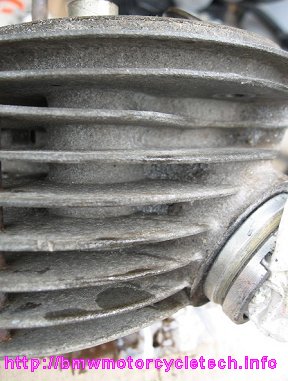
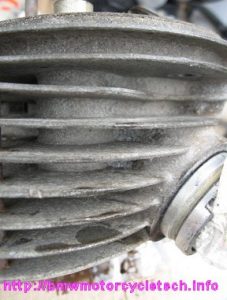
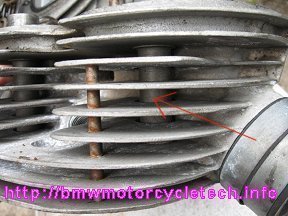
Below are two photos that will identify which head requires the O-rings.
Below head does not need the O-rings as the casting surrounds the tube.
Below head does need the O-rings, the large tube appears with no surrounding casting. NOTE THE RED ARROW!
Disassembly:
For information on the cylinder base shims: https://bmwmotorcycletech.info/cylinders.htm
First set the pistons at the OT mark on the flywheel/clutch carrier; that means pistons are fully outwards. Then remove the valve covers slowly and carefully so as to not tear their gaskets, and remove the spark plugs. Loosen the rocker arms valve clearance adjusters almost entirely, so the rocker is very free to move over a very wide arc. Check the rocker bearings, whether the old /5 pressed sleeve type or the later needle bearing type, by twisting the rocker sideways (angularly). Inspect the ends of the rocker arms, particularly the lower side, where the needle bearings (not /5) are pressed-in …if bad, replace the bearings. /5 models use bushes, not needle bearings, unless upgraded previously. Here is a link to my website having specific information on how to swap-around the original type of /5 rockers themselves to extend their life (without having to replace the bushings): https://bmwmotorcycletech.info/headassy.htm.
There is a considerable amount of information on these rockers, bushes ….and for later valve gear, ….in that linked article! Good idea to read it completely!
Undo the 6 head nuts, in stages, evenly, & remove the valve gear. Do not disassemble the valve gear (keep the shafts, rockers, blocks, all together as units), nor mix the parts from one cylinder to the other, nor mix up exhaust/intake rocker assembly parts. Do not pull the rocker assemblies apart as needles may fall out. If you do, the correct number of needles is one less than what will just not quite fit. Again, leave things together, remove the rocker assembly as just that, an assembly. It is a good idea to inspect the needle bearing rockers for any problems with the needle cage ends. Look particularly at the rolled-over ends of the needle bearing holders. Don’t pull the shafts unnecessarily out of the rockers. There are tiny needles in the later models, & some can move into the center area. Those can be a minor PIA to put back in place as noted. Both 31 and 32 needle models have been made.
CAUTION-3:
The punch-prick offset marked & angularly drilled shafts can be rotated end for end for additional life, with the mark now facing inwards. But, do check the drilling in the shaft first …be sure yours are such that oiling is maintained. The rocker shaft will likely have a round darkened area on one end, or you will seen a punch prick mark. You have probably been told that the darkened area must be on top, the punch mark, when present, must be outwards, all as when reassembled. Actually, having the punch mark outward is not absolutely necessary, with the angularly drilled shafts (but not all were).
Best for you to do it this way:
Top, outwards. This avoids me having to make a very lengthy technical explanation with graphics & have you check your particular shafts for proper drilling.
Remove the cylinder head & remove the pushrods. I roll the pushrods on a flat surface, to be sure they are not bent.
Pull the cylinder outward just enough so that the rear piston pin clip is just fully showing. By not pulling the cylinder off more, which means not removing the piston further, you keep the piston rings inside the cylinder. If you are doing a thorough de-coking, or measuring taper or ring gaps, then remove the cylinder off the piston, but in any case don’t let the rod fall; and for extra protection from that, do stuff a rag under the rod …as you do NOT want the rod to nick the case!; that will make for oil leaks, unless you carefully dress the nicks out. If you decide to remove a piston clip & remove the piston pin (you may have to heat the piston to remove the piston pin), be careful with the pin clip groove. Vorn marking & arrow on the top of the piston means that the arrow points forward on re-assembly. That is important; and, note that, rarely, a piston is not marked correctly. Do check …more a bit later on that!
Don’t be ham-fisted about the piston pin clip. Once the rear one is removed you can push the pin to rear (heat piston if needed) & carefully place the rod downward on the rag; pull the cylinder off, piston & rings still in the cylinder. No nicks are allowable from the rod onto the cylinder base area! Do not mess up the piston pin area. I usually replace the clips, which is the best policy. When replacing wrist pin circlips, they have a sharp side & a rounded side; the rounded side goes inwards, & orient the gap towards the engine case. Be SURE the piston pin clip is 100% properly seated, …try rotating it to be extra sure.
If the piston pin seems too tight to push rearward, look for metal fouling at the clip area …the tiniest hardly visible amount is too much & will keep the pin from being pushable. Still too tight? Try using a hair dryer to heat the piston. Heating the piston expands the aluminum far faster than the steel pin. Problems?….see the next several paragraphs.
Only in a rare case with a heated piston have I had to use a simple home-made device to remove the pin, the so-called ‘draw-bar’ method. A draw bar can be simple. Do get rid of proud metal at the clip place, and do try heating the piston pin area quite hot first. For a drawbar, if such is necessary, you will need a piece of all-thread from the hardware store (& get 2 nuts), not too large in diameter, or it won’t fit through the pin. Use some sockets from your socket set, or a big selection of washers & nuts, & draw the piston pin out. I’ve even used sockets or other proper diameter spacers and very large C clamps. Below are details & an example of how you might do this. CAUTION! ….You must not put pressure on a piston clip! Huge amounts of pressure are not need, and is not to be done in this pin removal procedure. You can do this procedure by removing the pin to the rear, or to the front. I assume that you have removed the rear piston pin clip so the pin will come out rearwards. That clip is often called a keeper. This procedure works well for piston pins that have the center hole totally available to put a piece of all-thread through it. There are types of piston pin keepers that don’t allow this unless both are removed.
Read this procedure through, before doing any cutting …know what you are going to do!
1. Cut the all-thread to reasonable length with the nut ALREADY on the end to be cut, with the threaded area to be cut off not having the nut on it. This means you must put the nut on first, with the threads to be removed showing at the end. I clamp the nut lightly in my bench vise, then I cut off any unneeded threaded material. Clean up the end with a file, wire wheel, whatever, & then unscrew the nut, removing it completely, to finish re-forming the cut threads . You can now do a final cleaning of the first thread. The all-thread needs to be long enough to enable nuts, washers, sockets, whatever, as spacers on it. Better way long than too short. Put the piece of all-thread through the hollow piston pin. At the forward end (assuming pin will be pushed rearwards in this procedure), put a washer or socket, sized such that it fits the piston pin end, but does not pull into the insides of the pin, nor put pressure on the piston, nor clip, if it is there. In other words, sized just a bit less than the pin diameter. Add a nut. Check & recheck the size of your items being used as a spacer/mandrel. You do not want to damage a piston pin bore or clip, or pin.
2. At the rearward part of the pin, where you removed the clip, put a large socket that is much larger on its inside than the piston pin; add a washer if needed for the nut to bear on. Put on a nut. Tighten this rear nut. The tool will draw the pin to the rear. I suggest this be done with the piston hot. Watch what you are doing …you do not want to injure the piston pin bore area. You may have to put a large socket or piece of pipe, etc., that fits & clears, over the pin, & repeat the pulling, over & over. Note that you can improvise, a lot, on this technique. Done properly, you will not scratch the piston bore where the pin fits the piston. The pin is a much easier fit in the rod, & you need only remove the pin enough to free it from the rod (don’t let the rod fall).
3. Some pins fit tightly, & heat …and more rarely heat & the drawbar method …are needed. Do not go to the effort of the drawbar method if a pin removes without a drawbar. If the pin does not move, then heating is the first thing to try. Simple heating of the piston with such as a hair drier works may allow you to push the pin out with your thumb. Pins and piston bores are a very carefully machined fit. Be really careful not to damage the piston pin keeper area. If you put the slightest nick in the area, you will have to remove it with a sharp knife or some other method, or the pin will not remove easily, nor will it go back in place easy, later.
4. With the pin is out of the piston & rod (do not let the rod fall and nick the engine case); the rod gently placed on a rag on the engine casting hole entrance; you can pull off the cylinder, with the piston & its rings still in the cylinder …..you need to remove the piston, of course, if doing a ring job, honing, …etc.
Assembly and break-in:
For information on the cylinder base shims, see: https://bmwmotorcycletech.info/cylinders.htm
http://bmwmotorcycletech.info/pistons.htm has the correct orientation of the piston rings, and lots more.
Pistons occasionally are manufactured with the VORN marking and arrow stamped wrongly …that is, in the 180° reversed position! Be sure you have the piston installed in the correct direction! Pistons have the larger cutout relief for the intake valve, and this larger cutout always faces the rear on Airheads. Piston pins are also not dead centered in many types of pistons ….that isn’t easy for you to measure ….so is just a somewhat nerdy mention here, and the not perfectly centered pin is done that way in order to help accommodate the thrust direction (picture in your mind the piston rod on an angle)
I suggest that you do not use the BMW owner’s booklet method of break-in; IMO, it is for an engine already briefly run at the factory.
OIL:
You may be ‘breaking in’ a ring job or pistons, rings, cylinders, or bore job, or some combination. BMW, long ago, installed a special 20W20 oil delivered with new bikes; I do not know what they use presently. There is no absolute need for special oils if you are breaking-in new rings; but there are some strong suggestions by me. I suggest a SG type oil, non-synthetic; a 10W40 for break-in; although a semi-synthetic is OK, as is 15W50 or 20W50. A NON-synthetic (non-part-synthetic too) MAY allow faster break-in. BMW (me too) says a full break-in may take 6000 miles, for minimal oil consumption. Do not use a full synthetic oil for initial break-in. See next two paragraphs. I recommend you break-in the top end of the engine using a decent motorcycle oil, my preference being Golden Spectro 4 which is a part-synthetic; but I approve of NON-part-synthetic oil too. Spectro makes such an oil & it works delightfully for break-in. Repeated: Do not use a full synthetic oil for break-in.
I strongly suggest you do not flood the rings, cylinders, nor pistons, with oil during assembly. Use at most a dozen drops of engine oil on your hands, & then wipe your hands onto the piston skirts & rings. I do it to the cylinder walls too, but only faintly (but all over). Excessive oil causes carboning-up, particularly on new rings, & inhibits break-in.
I recommend that the engine not be babied. This is especially important at high altitudes where cylinder pressures, even with full throttle, are much lower. Lower cylinder pressures mean that the rings are not being forced against the cylinder walls with as much pressure. The problem that arises with too gentle use of the throttle is various forms of glazing, and failure to seat the rings and cylinder walls properly, the result is excessive blowby and oil usage.
Install a new oil filter when installing the fresh oil, using the starter motor (no fuel in carbs so engine will not start) to fill the oil canister area (oil light goes out). Start the engine using a minimal amount of ‘choke’, and within seconds move the rpm to about 3000 & hold it there for maybe 15 seconds, then move it upwards to maybe 3500 or even 4000 …for perhaps a minute. Turn off the engine after that minute & check for oil leaks.
Immediately put on your riding gear. Restart the engine; and, with no waiting, go for a ride. I do not baby the engine much …I use a fair amount of throttle but NOT at nor near maximum, …. although at high altitudes I would do maximum for a few seconds at a time ….But ….even with maximum throttle (or not) do not use over 4500 rpm for the first dozen or so miles. Keep the engine around 3000-4500, as best you can, backing off the throttle fully every few blocks (or, every half-mile), then increasing throttle so the rpm is back in that 3000-4500 range. Backing off the throttle is important, to allow the engine to ‘suck’ oil up into those areas needing it. Might be a good idea for you to re-read and fully memorize this paragraph.
As you get ~ 5 to 10 miles on the engine, you can begin to use slightly longer stretches before backing off the throttle. The idea is still for oil to be sucked into the rings & valve guide areas when the throttle is snapped off. The snapping-off works best if you can do it for at least 3 to 5 seconds. It is OK to use a fair amount of throttle, but usually not wide-open throttle (I DO use full throttle for a few seconds, often, if at high altitude, that is, over 5000 feet), and do not use extremely high rpm, absolutely not near redline! After a dozen+ miles, you can move slightly higher in rpm. Don’t idle the engine for long periods of time. No redline RPM. Keep WELL below any yellow area too! After a fair amount of miles, stop, turn off the engine, & again check for oil leaks. If no leaks, continue your ride. As initial break-in continues, you can use higher & higher rpm for short bursts. I suggest generally staying under 5500 for the first 100 miles, and this applies to all sizes of Airheads engines.
I suggest continuing the initial break-in somewhat as in the Rider’s Manual …modest rpm, vary the rpm, vary the throttle, etc., & avoid very high rpm. You can go 600 miles before an oil change, due to the oil/filter system. For the very best for your engine, I suggest after 100 miles or so you change the oil to a quality 20W50 MOTORCYCLE oil (if that is not in the engine) but do not use a full synthetic (should you plan to, eventually) until the engine is fully broken-in, which can often take several thousand miles. Full synthetics are not needed on an Airhead, but can be used if you so prefer, after full break-in.
Change the filter. Hang the old filter by a piece of coat-hangar wire overnight. The next day inspect the pleating by prying the metal ends off the filter with a pliers of some sort, then knife-slit the outer wrap, then unroll & inspect all pleats …on both sides. It’s a good time to check the valve clearances with the engine cool. Check the valves again after 600 more miles, particularly important if the valve clearances are changing a fair amount. You want to be sure the valves are stable over time. Once the valves are stable, every 5000 miles for a check is OK. I keep written records of as-found valve clearances at every check, before the head bolts are checked for torque. I suggest you do not torque the heads at every valve adjustment/check. Initially upon assembly, then at maybe 100, 600, 5000, and then very seldom. The rocker arm end play adjustment does require loosening the 2 rocker nuts (do ONE rocker at a time), so that is a good time to torque all 6 nuts per cylinder.
Assembly and break-in; ….in lots more depth:
The so-called dry cylinder break-in information was posted quite a few times to the Airheads LIST by Tom Cutter. My method is similar (and is shown above). I am using Tom’s posting as a basis for what follows. I have edited it for syntax & clarity. Still, what follows is my method, combined with Tom’s method, said somewhat differently than previously. We do not differ much between us! Further, our procedure is nearly the same as BMW posted (via Butler and Smith) decades ago.
The “Dry cylinder” method does not mean ‘don’t oil anything’. It means don’t flood everything with oil on assembly and do not use special “assembly lubes” for the cylinders, pistons and rings. I use such extreme pressure lubricants only for assembling connecting rod bearings, mains bearings, camshafts, & cam followers.
Honing: Be careful that you understand what honing means. Basically, honing puts a desired surface finish into the cylinder. During the process, the rotary hone and its RPM and its vertical speed as it goes up and down through the cylinder, creates a visible cross-hatch type of finish. This is the basic process cylinders, whether or not the cylinder is later ‘plated’ with something like Nikasil/Galnikal. The cross-hatch pattern angle has been debated, but done properly, the engine will break-in nicely & also use less oil, and the cylinder will last longer, ETC. The crosshatch pattern has quite an effect on ring rotation, and some other things.
Honing seems to often mean different things to different folks, & is not the same thing for honing a fresh bore job on an older iron cylinder, as what it means for a Nikasil or Galnikal cylinder which are not truly going to be honed, that was probably done before the “plating” or by a plasma coating. When the cylinder is being prepared for installation into your motorcycle, you must thoroughly clean & wash the cylinders & pistons, rings, etc. with a solvent. Tom uses Safety-Kleen solvent, I use kerosene or paint thinner, ETC.. I finish with hot soapy-detergent-water, then follow that with a hot water rinse.
I do not “hone” Nikasil or Galnikal cylinders ….although Tom feels a simple “ball-hone” “could be” briefly used (I agree). I use 3M type plastic scouring pads with plenty of soap & water to clean Nikasil/Galnikal cylinders. These shouldn’t be considered for conventional abrasive honing. The factory Nikasil honing marks are usually quite visible, and last a tremendously long time/mileage.
After washing, blow dry with compressed air & leave in the sun to dry. If you don’t have compressed air, use clean, soft and absorbent cotton to dry the cylinder bores.
On the iron cylinders (Airheads pre-Nikasil/Galnikal), I generally let the cylinders, after the soap, water & sort-of drying, to sit in my garage or storage shed, to actually get a very faint patina of rust, which may or may not be noticeable. Usually overnight is enough. But, I may let it go longer. Then I use a very slightly oily rag …or my slightly oiled hands …in the next day or two or three ….to wipe the cylinder walls. This prevents more surface rust, & makes everything slide together well, & leaves a truly faint abrasive-lubrication layer. You want the surface just barely noticeable as faintly having a sheen of oil (at most).
Nikasil or Galnikal cylinders do not really rust, but the FAINT amount of oil from one’s hands, as earlier described, fills in some pores & irregularities.
Summing-up: I use a faint amount of oil on both the iron & Nikasil or Galnikal cylinders, but I never have a wet squirted-on oiled cylinder look.
HOW TO ASSEMBLE:
Assemble the rings onto the pistons if they are not already so. I prefer to do my faint oiling to the cylinder walls and the pistons with the rings on the pistons. I caution that rings are very brittle and you must install them correctly and not upside down, & the gaps are to be at 120° & the gaps at the O’clock I specify below. I have my methods of installing the rings, but you can use an old thin feeler gauge to help you, using it as a sliding surface. Here is the proper orientation of the ring end gaps, based on the common analog clock, as you face that side of the engine:
LEFT SIDE:
Outer, compression ring: 4:30
2nd ring: 10:30
Innermost (oil ring): 1:30
RIGHT SIDE:
Outer, compression ring: 7:30
2nd ring: 1:30
Innermost (oil ring): 10:30
YOU MAY WANT TO READ THIS ENTIRE ARTICLE:
https://bmwmotorcycletech.info/pistons.htm
NEXT: Install the pistons into the bottom of the cylinders until just the skirts & wristpin hole is showing. VORN and the arrow on the top of the piston faces forward! Some few pistons were mismarked. The exhaust cutout is the smaller one. Then slide the cylinder (if the cylinder uses the very large O-ring at the cylinder bottom install it first) onto the studs; line up the rod wristpin holes. Put a few drops of oil (or, assembly lube) on your fingers & oil the wristpin & bores, then install the pin & clip. Be sure that if your clip is sharp on one side & not the other, that it is installed correctly as previously outlined in this article! Be sure it is fully installed! If the pin is tight, heat the piston with a heat gun. If the pin is still tight, clean the burrs in the pin bore. Once the piston pin is installed & its clip is secure (put a rag in the crankcase hole to keep the pin from flying in there) you are ready to finish installing the cylinder.
Apply a very thin coating of your sealant of choice (I no longer recommend Hylomar) onto the cylinder base sealing surface & both sides of the shim/gasket/compression-plate (if the bike uses gaskets or compression plates …information on these is found, in depth, in: https://bmwmotorcycletech.info/cylinders.htm as well as onto the crankcase surface. The sealant must be very thinly applied if you are doing it to all 4 surfaces. Some only coat the shim on both sides (if there is a shim). Finger-tip applicator is best. If you use a brush do not allow any bristles to remain …none!! Be sure you know exactly where & how to install the sealant. It is placed very carefully on the cylinder base and especially carefully on the engine case, around the top two studs. The top two studs are critical where they meet the engine case. The only oil for the rockers, and other parts of the top end, is via the oil that comes to the head along the studs! There are tiny oil ports where the top two studs of each cylinder fit into the engine case!
If you use Hylomar, & with some others, warm the tube of the stuff somewhat so it’s brushable (or finger-tip-able). The film must be very thin & relatively even. There must not be any brush bristles left on the surface. There have been a few problems using Hylomar, the sealing fails, usually after some longish period of time, possibly due to imperfect application. Hylomar is a bit safer however, than many other sealants, if a tiny wee bit gets into the oiling system from a slight over-exuberant amount at the top studs. Most of us are now using a more modern sealant. Please refer to the following article for recommendations on cylinder base sealants & applying them:
https://bmwmotorcycletech.info/chemicalsetc.htm
Apply two or three drops of regular non-synthetic (part-synthetic is OK) motor oil to each side of the piston skirt, top and bottom, and the cylinder walls ….smearing it on evenly with your hands. I usually put these few drops of oil on my hands, rub my hands together, and then use what is on my hands to very faintly coat the piston and cylinder walls. I do not use ‘assembly lubes’ here.
Lightly oil the pushrod tube rubbers on their outsides so they can slide into position. I use a faint smear of silicone grease on the inside of the pushrod tube rubbers, where the pushrod tube fits. I use engine oil on the outside of the rubbers where they fit into the engine casting. Silicone grease is often called, at autoparts stores, silicone dielectric grease, or similar.
If your cylinder (1979+, usually) uses the very large O-ring at the base, now, not earlier, is the time to oil it, using your finger, using engine oil. I also now oil the small O-rings at the top two studs at the engine case. Within a minute or three, push the cylinder fully home. Don’t extend this time to hours, as the O-rings might expand. Do not delay, go to the next step:
Next, install the head gasket so the writing faces you, (double check that there is no gasket covering any portion of the head pushrod tube holes …if there is, the gasket is reversed, no matter the writing faces!), & install the heads & well-oiled rocker arm bushes/bearings, without delay. I do the head tightening with a bit of bias to the bottom two nuts of the rocker assemblies; as, otherwise, the push rod rubbers act a bit like a canting (angular), spring.
Torque the the cylinder head in a cross pattern, but in a progressive 3-step torque sequence, to 25.0 foot pounds of torque. BMW never specified in any detail if the 4 rocker nuts & associated studs are to have oiled threads, or not, when assembling & tightening the 6 nuts per cylinder head. I, however, will tell you. You should oil the 4 rocker arm stud threads (on each cylinder head) & also oil the nuts threads ….before screwing on the nut. If they ever squeak during tightening or loosening, remove, oil, re-torque. If you oil those two nuts, do it skimpily. It is not absolutely necessary to have any oil on the threads on the two head nuts, located at 12:00 and 6:00, although a trace of oil film is fine on them …and that is what I do …either a scant one drop on the stud threads before I put the nuts on, or, I simply have a slight bit of oil in the solvent when I am cleaning the threads.
Tighten the 6 nuts holding the head & cylinder evenly & in a cross pattern. Do this only on a cool engine. Once the cylinder is pretty well up to the engine then be sure to ‘stage’ the torque settings, perhaps first at a few ftlbs, then 11 ftlbs and then 18 ftlbs. Do that in the same cross pattern. Do not go directly to the final 25 ftlbs value. The final torque setting varies officially by year and cylinder type, but if you use 26.0 ftlbs as an absolute maximum for all BMW Airheads and try for 25 ftlbs, that is excellent. I set my known-good torque wrench to 25 ftlbs for the final tightening. Disregard any advice in literature that, especially on the old iron sleeve cylinders, says to use 29-31 ftlbs. Do not exceed an absolute maximum of a true 26. Be sure your torque wrench is accurate.
Do not use a torque wrench of quite high maximum available setting. Use of such as a 150 ftlb maximum setting torque wrench will result in probable poor accuracy at a much lower setting like 25. A 75 ftlb maximum torque wrench is what you probably should be using. Besides the inaccuracy at low settings for high limits torque wrenches, there is another problem with them. Many torque wrenches have an extremely soft ‘feel’ or ‘click’ at low settings. This even happens on 75 ftlbs torque wrenches if used near the very minimum setting. I have seen folks put a lot of torque on the six head nuts …beyond the 26 ftlb max …simply because they did not know what to feel for. If you do not know how your torque wrench feels (and sounds), test it on something other than your top end nuts! Put the square drive into your bench vise, and feel and listen for the click.
I absolutely will not use a beam type torque wrench for this job, unless it is the industrial type, that has a GAUGE on it.
Rockers (rocker arms):
A good reference for the rockers, which has some photos and discussion, is: http://largiader.com/tech/rockers. That is Anton Largiader’s site, and he has photos in that article of what the various years of rocker items look like, etc. If my memory is good here, the early rocker arms were ~56 mm wide. The later ones used from 1985, were ~51 mm, to allow for the shims used on the 1985+ rocker arms. If I get a chance, I will measure them and post the exact measurements here. Not really important as wrong ones absolutely will not fit.
If the adjustment of the cup-bolt (to set valve clearance) is not adequate after head has been milled, see the information in: https://bmwmotorcycletech.info/valves.htm
You can now (or later) adjust the rocker arms for end clearance, and then (or, do later) valves for clearance. Valves must be adjusted with a cool engine with the particular cylinder at the OT mark ON THAT PARTICULAR CYLINDER’S COMPRESSION STROKE. When doing end play adjustment, the rockers must be free; I suggest they be tested that they will rotate easily and fully. Have the push rod adjustors backed way way off for that. Proper end play is such that up & down pushing on the rocker will “just” show the oil film to move at where the rocker meets the rocker mounts. I personally do the first rocker end play & valves clearances adjustments all immediately after the cylinders & heads are installed. I do it during the torquing of the rocker nuts.
In ~600 miles do another valve clearance check; re-check the head torque at that time; check the end play too. Keep records on clearances as found before torquing the heads; ….so you have trend information!
Late models (1985+) have clearance specifications, and the rocker end play is set with shims. I still use the oil film method check.
Double check that there is a proper level of engine oil!! Folks have done top end work and forgotten to put oil in the engine (assuming they drained it!)!
Prepare your carburetor adjustment tools, for later.
Follow initial startup & initial break-in, as shown earlier in this article. It is important that the very first startup be per my instructions. If carburetors were worked on, do a preliminary adjusting the carburetors without starting the engine.
Cylinder head SPIGOTS (these are the threaded (at cylinder head end) steel large round metal intake stubs that are screwed into the cylinder head that the carburetors mount to via hoses and band clamps):
Occasionally they come loose or are leaking. Spray brake cleaner or other stuff at the junction at idle, there must be no rpm/sound change. Generally speaking, we ‘Wrenches’ have advised removing spigots by first heating the head fairly hot, which expands much faster, being of aluminum, than the spigot. Re-install the spigots quite tightly after coating the threads with Loctite Red. The factory installed them, or was supposed-to, with a green colored wicking (that means low viscosity) Loctite, at a specified torque & head temperature. For reference specifications purposes here, BMW said 240°C (which is 572°F)…that is extremely HOT! … I never heat the heads that hot. The factory also said to use a torque of 12 mkp, which is approx 86 ftlbs. My guess is that BMW may have installed the spigots before final assembly or even final machining, but I do not know. In any event, please do not heat them that hot!
I want to make this clear: It is my belief that BMW can get away with such temperatures since the heads are probably not yet finished-off. They are also using a wicking Loctite application. You should not. I strongly suggest you do NOT heat the heads that hot! I suggest: Heat head to water sizzle temperature (about 100°C, 212°F) or somewhat more. I use an electric hot plate, with a separating piece of aluminum. I suggest that you do not go over 300°F. I clamp the head into my bench vice, using wood in the jaws to not injure the head in any way. Prepare for this ahead of time. Use a common strap wrench, Loctite RED on the spigot threads, and install TIGHT! No strap wrench? Make up one from an old leather waist belt. Spigots with carburetor end slots? …you can use something as a tool ….such as a flat piece of steel. TIGHT!!
If the engine is already assembled, run the engine until fairly hot, then shut off the engine, remove the spigots, and reinstall, red-Loctite’d, and quite tight.
Repairing pulled cylinder stud threads:
CAUTION-4: you cannot follow directions, do not do these repairs yourself)
There is additional information on special tools, in my tools article, #20: https://bmwmotorcycletech.info/tools.htm
CAUTION-5: ….never tighten the 4 rocker arm nuts if the engine is warm/hot. That can cause pulled-threads.
Four per side long studs are screwed into the cases. These hold the cylinders and heads to the engine. Most are 275 mm in length, part number 11-11-1-257-397 and are size 10 x 1.5 mm threaded. There could be 1 or two of these in a longer length. In particular, the right rear may be longer, 297 mm, 11-11-1-265-195 297. It is used at the right cylinder. This probably started with the /7 bikes.
Cylinder studs are to be installed so they are 9-15/16″ to 10″ from the engine pad; 10.0″ is the goal. Do not use Loctite on the threads!
I like Helicoils far better than TimeSerts or similar for when you need them. Properly done, a Helicoil job has no oil passageway flow problems. If you are repairing a botched-job, you may well require special advice, I suggest you post your questions on the Airheads LIST. See below for the best tools and repairs, HPD …and there are others that are good enough.
Done properly, a pulled stud repair can be as or stronger than the original. In most instances, a proper repair is considerably stronger than the original. Only in extremely rare truly horribly bad instances have I found it necessary to do welding and machining. One must be careful about the oil galley feeds to the top studs, no matter how repaired. You also must be absolutely sure the hole and threads are at exactly 90° to the outer surface. A drilling guide and tapping guide is a must! Such a guide is usually a simple metal spacer of reasonable length and outside diameter, with a proper internal hole. These can be purchased, or made on a lathe, and cylinder stud repair kits you can purchase (or, borrow!) almost always have such guides or similar function items. DO NOT think you can drill and tap squarely without a guide part of some sort.
The best repair is done with special tools and inserts. This is particularly true for the upper front LEFT SIDE thread, which BMW had factory assembly problems with on the later Airheads. I recommend HPD (High Precision Devices) tools. The tools must be used correctly! http://www.hpd-online.com/stud-tool.php (303) 447-2558. They are expensive. It may be considerably cheaper to get the bike to someplace that has this particular set of tools. This is NOT a standard Helicoil repair. You could also ‘rent’ a tool:
http://www.northwoodsairheads.com/cyl-stud-jig.php
CAUTION-6, WARNING: I cannot over-emphasize that the threaded holes in the engine case that are used for the 4 long studs for each cylinder must be repaired properly, should they need repairs. Pulled threads are common. BMW themselves installed special length Helicoils on the Airheads motorcycles at certain positions, due to casting problems. If you take your motorcycle to a repair shop, friend, etc., & they are going to be drilling or tapping your case holes by using a hand drill, electric or not, & not using a proper drilling/tapping guides, do not …NOT!…let them touch your bike, NO MATTER WHAT THEY SAY ABOUT HAVING DONE THIS JOB PREVIOUSLY FOR OTHERS. Failure to heed my advice could result in, worst instance, a scrapped engine block. Use of correct tools to do the job should be thought of as mandatory.
Using a Professional, even an Airhead ‘specialist’…? Ask what jig or drill/tapping guides tooling they will use. If leaving your bike/engine for such repairs, ASK to SEE those tools! You want to KNOW they have them AND will USE THEM.
The rest of this section of the article, before getting into the cylinders, O-rings, etc., is devoted to the problems with the case threads.
BE SURE YOU UNDERSTAND: ALL oil for the valve guides, rockers, pushrod tips, and some oil for the cam followers and camshaft, etc., comes from the high pressure oil gallery (think of a gallery as an internal pipe, typically cast-into the engine block). The gallery is supplied from the oil pump and oil filter. The gallery supplies oil to the “top end” via two holes located in the engine case, each of the two holes is located at the two top cylinder studs area of the engine case. To repair pulled threads, where a stud has pulled out of the engine case or is close to it, it must be done properly, as there is a lot of torque on those studs when tightening the head nuts. Additionaly, you must ensure that the oil passages continue to be functional. Note that the path of the oil to the cylinder head is along the two upper studs themselves! I recommend the oil passages at the top studs be plugged during your machining work. You could use candle wax ….remove it when done. A typical repair will have you using a special guide to allow precision drilling & tapping threads at 90 degrees & installing a special extra-long Helicoil at the top stud area. Rags should be stuffed into the ~4 inch hole where the cylinder fits. Grease the drill and same for the tap, to grab chips during the repair process.
If you are not doing the repair with the HPD tools:
The standard fix for pulled threads is to use a Helicoil drill & Helicoil tap & tool that comes in a Helicoil kit. The thread that you are going to make in the case is 12 x 1.5. The Helicoil is then inserted into that 12 x 1.5 thread. The Helicoil has the same pitch (1.5). The Helicoil, after installation, has the same internal threads as the original stock 10 mm in the engine case where the stud screws-in. Because the Helicoil is very tough metal, and is, itself, screwed into a 12 mm threaded hole, the resulting 10 mm threads are very strong.
If the threads are fully pulled-out, you probably won’t need to drill the area.
BMW does not use the standard 9 coil (typically) that one finds in stock at your local Helicoil dealer. BMW uses a Helicoil that is longer, that is, it has 12 coils. The BMW Helicoil is …or is supposed to be …already coated with Loctite. There is no need to get the entire BMW kit. You can order the special long Helicoils from BMW, 11-11-1-338-630. The entire kit is BMW part number 88-88-6-112-730, and it includes a Helicoil tap, a tool, and a drift tool. Expensive! Perhaps worth it though! BMW rightly said that if the threads were totally pulled out, one need not drill (a guide is needed if you drill!), and one could proceed directly to the tapping for the Helicoil. Tapping must be done with the special Helicoil manufactured tap, & a tapping guide. I suggest, MOST emphatically!… that this job never be done, drilling or tapping, without a truly proper guide! Drilling & tapping is critical! If you plan to have this repair done by someone that tells you that he can do it with an electric drill, by hand, without a guide piece …RUN LIKE HELL! Even a slight angle will be reflected in a large amount of stud offset at the head ….and bad things can happen over time. There can also be problems with the oil gallery holes.
You can also obtain longer Helicoils from Helicoil dealers. Use of the long Helicoil ensures a very strong repair. Use the regular Helicoil tap tool, etc. Again, I emphasize: A drilling and/or tapping guide is absolutely necessary to ensure a dead straight & square repair. Information on some of this is in the 12/92 service microfiche, page 3, area I23 and J23. The SI was 11-047-91 (2461), and covers all R models. The SI calls out installing the Helicoil to a depth such that it is 2 mm below the surface. NOTE, that BMW had a note on this SI….stating, my words here, that the correct specification for torque, using a known calibrated torque wrench, was 25 +- 2 foot pounds, and that “this did not mean torque to 27”. BMW wants Loctite on its inserts, and supplies their 12 coil insert with such a coating, per their books. I have literature from the Helicoil company that says not to use Loctite on their inserts, as it can cause them to slip (rotate). I disregard that as I think BMW is correct ….in this instance. I install Helicoils with Loctite RED, and after a full cure (a few days, no matter what you are told), I thoroughly clean any excess Loctite using Q-tips and acetone …I don’t want any excess or uncured Loctite to be in the stud threads area that the stud screws into ….just want Loctite in the engine case threads interface to the Helicoil itself. If you are at a TechDay, etc., and have to do the repair and reassemble the engine now, without waiting for the full Loctite cure, just be careful, and you will probably be OK. Do clean out the excess Loctite before installing the stud(s).
In the top studs case threads area, the oil gallery outlets are at 12:00. Be exceptionally careful about the oil function ….do not block the galley hole, and do ensure that the Helicoil does not interfere (the Helicoil is installed below flush), ETC. Remember, there is a rubber O-ring used on most models there too. Think about that O-ring …it seals for oil leaks & must still allow for oil to pass to the top end. A very close “thinking man’s look-see” is needed to understand how the oil gets to the top end. Lots of oil pressure here too.
The threads in the crankcase are particularly vulnerable to over-torquing at the left cylinder, front upper left stud. The BMW factory issued a bulletin quite some time ago, that said that they were installing, as standard, a Helicoil (BMW named the Helicoil brand), at that front stud. The Bulletin was not overly clear. Factory installed Helicoils are special, 12 turns, have a sort of bottoming internal-facing bump down partway. These were usually installed only at the upper front left stud threads, but I have seen them at other places. We don’t know the official reason, could be some weakness in the casting there, or?? If you find Helicoils, you now know it is quite possibly a factory installation …rather than a previous owner’s repair. Some of BMW’s literature is vague on this point, but it is the left upper front that typically has the factory Helicoil (although can be at other top stud holes).
I have emphasized that any drilling &/or tapping has to be done very squarely to the case area. Any decent machinist will know that, & comply with a specially made up tool; but that tool might be so-so, although may be OK. I used, years ago, modified cylinder bases, with the holes bored and long hardened inserts in those holes. Few in the USA have the really proper fixture to do this job squarely and properly in every respect. Those that do (this may well be a too-short list) are:
Tom Cutter in Pennsylvania Rubberchickenracinggarage.com
Anton Largiader in Virginia Largiader.com
Ted Porter in California Beemershop.com
The above have fancy versions of these tools, that do an excellent job. As time goes by, perhaps more people will have the correct tools.
Want to do it yourself (buy or rent the tools?)…>>> see item #20 at this link: https://bmwmotorcycletech.info/tools.htm
BMW advises that if a stud itself is stretched at the threads, it should be replaced.
Now and then we see a badly repaired case thread. It might have had a Timesert installed, or drilling or tapping on an angle or otherwise badly done; or, perhaps the Helicoil was improperly installed, etc. For a pulled Helicoil, there is a fix, if you are careful and the case is not too badly screwed-up! The Helicoil company makes a TWINSERT ….it is a Helicoil inside a Helicoil, and is available extra long …which is a must. Try www.olander.com for the proper parts, including the 12.5 mm drill, the Twinsert tap, and the long Twinsert inserts ….or just rent most or all of the stuff you need (see that tools article, item 20, as noted above).
MORE DETAILS on cylinders, O-rings, etc.:
Earliest Airheads do not have counter-boring at the top studs areas of the cases for fitting the small O-rings, because these O-rings were not then used. Soon came the counter-boring in the cases for those O-rings.
Later, cylinders incorporated a machined groove for a large O-ring located around the bottom of the cylinder, this was for 1978 & later. Some 1978 did not have the groove. That O-ring was WHITE, a special BMW part, & was designed to be engine oil wetted just prior to the cylinder being installed and torqued. I actually wet all the O-rings just prior to final assembly. Oil wetting should be done within an hour of assembly. The oil will supposedly slowly cause the O-rings to swell …so mind the maximum 1 hour period.
The original large O-ring, was 2.0 mm x 99 mm, part 11-11-1-335-866. Information that I do not think is correct has been published, it is for the 78 (some)-79-80 years, without Nikasil cylinders, using the 2.20 mm oversize O-ring, which is part 11-11-1-337-567, and supposedly gave a bit better sealing. It was rumored that BMW was going to delete the 2.0 mm O-ring, but I thought that this was probably wrong & just confusion at the dealer level. However, BMW has, per the late #1 guru Oak, mixed up shipments of the white & black O-rings & seems to only ship the black ones. Tom Cutter has said that the 1990, perhaps it was 1991, crankcases are slightly different in the relief at the cylinder opening, and the 2.2 mm O-ring is to be used. Look at your crankcase carefully at the opening. This whole situation is confusing to me, particularly so since I personally have never had a problem fitting any of the O-rings. Because of the annoying amount of labor to fix a tiny leak, I always use a proper sealant, even on the late cylinder’d bikes, all years, at the cylinder base and case flat area, and on any metal gaskets used on some early models. The O-ring is extra protection against some (internal from crankcase) leaks, is how I deal with it. With either O-ring, I have never had leaks. I oil the O-rings within minutes prior to reassembly. The bottom line here is that I am not 100% sure about the O-rings, and folks ordering the -866 may well get the -567, even if they tell the dealer parts department person that they want only the 2.0 mm. For the nerdy, the cylinder O-ring area is reportedly OD 3.8899″ 98.78 mm; groove depth is .024″ or .61 mm; groove width .104″ or 2.64 mm.
I have speculated that BMW incorporated the large O-ring so to speed up the production line, as use of a sealant, theoretically, is not needed at the cylinder base and case flat area. I am not convinced of even trying to do that, so I never have installed cylinders without a sealant.
1978 & earlier without the large O-ring must have a sealant used.
Be careful with sealant around the top studs because of the oil passageways. Use sealant very sparingly, very thinly, very evenly, & it goes around the outside of the studs area of the block …not on the studs themselves, not in the oil passageways! Remember that the cylinder base, during torquing the stud nuts, will tend to squeeze-out almost all of this sealant …and ‘out’ can mean into the oil passageways. Do not let any brush bristles be left in the sealing area. I do the sealant application with my finger-tip, not brushes!
WARNING ……leave no brush bristles; and, if you nick the case opening you must dress out the nick, or you WILL have oil leaks.
I have removed much of my cylinder base sealant information from this & most other articles, so that there is only one place I need to update now and then. I keep the information at: https://bmwmotorcycletech.info/chemicalsetc.htm
Machining is possible for cylinders & if needed the cases, for whatever combination of cylinders & cases you want to use. The later cylinders not only have the machined groove & a slightly different shape near that groove which affects sealing if the case does not match; but, the effective cylinder length is also different, which causes a difference in compression ratio, by about half a point. So, now you know why various literature cites an odd compression ratio for later models. You can install any cylinder that fits the case hole, with or without the large O-ring, with minor cylinder machining (if required). If the cylinder spigot is too large, the case needs to be machined …or, you can machine the cylinder. In my opinion, for any combination of cases & cylinders, you should use a sealant, even on those cases & cylinders that use the small & large O-rings.
SHIMS, in brief:
The stock cylinder base shim, during 1970-1975, was 1/2 mm (~ .020″), & is not to be used for 1976 & later. For 1976+, two shims (BMW has used the word gasket for shims) were available & these are only for 1976 & later. The so-called Step 1 compression lowering gasket was .7 mm (.028″); and the very low compression gasket was 1.2 mm (.047″). The original part numbers were 11-11-1-257-092 for the /5, for lowering octane requirements. Used on /5 and /6 was the 11-11-1-255-001. Use of the 11-11-1-335-650 base gasket will lower a 9.2 CR to about 8.6. refer to: https://bmwmotorcycletech.info/cylinders.htm
Repeat of earlier information:
Do not damage the piston circlips if you intend to reuse them. I do not re-use them, I replace them every time. When removing or installing circlips, do not do more than just the amount of pressure and movement needed. >>>….the wrist pin circlips may have a sharp side, and a rounded side; the rounded side goes INWARDS.
rev:
07/18/2017: Copy from http://bmwmotorcycletech.info/break-in.htm which had all earlier revisions; edit for airheads.org.
01/20/2021: Minor cleanup
© Copyright 2021, R. Fleischer