
GERMAN WORDS YOU MIGHT WANT OR NEED TO KNOW
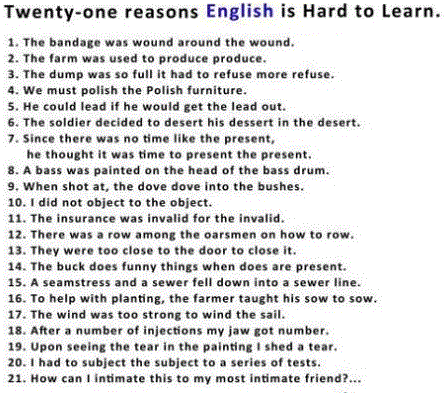
…and, at the end of the article, a humorous bit on why
English is such a problem to learn.
https://bmwmotorcycletech.info/germanwords.htm
© Copyright 2021, R. Fleischer
Most of the time there are few problems with native language documents translated into other languages and published by factories that make a product. Once in awhile a factory makes a SERIOUS mistake. One such is from the math-challenged person who translated the BMW correct torques specified in Nm (if, in MY opinion, sometimes too high) to incorrect values in Footpounds (or, pounds-feet). This is how incorrect Ftlbs values were then widely published in BMW factory literature. Aftermarket publications would usually assume the factory was correct, and carry on the incorrect values. This can result in serious problems, so, translate those Nm figures yourself! You may want to read article 71A , 71B, and 71C, on the author’s website, https://bmwmotorcycletech.info.
Sometimes, although rarely, there are problems with spelling and/or sound, resulting in a wrong meaning. The German “Auf” is such a situation. It does NOT mean OFF!
We usually order by part number or perhaps from a sketch or we describe where it goes/fits/etc. Almost all the time, this works quite well. Not always. Be cautious about numbers on things. Examples are the use of BOSCH numbers; and partial BMW numbers. Be aware that BMW markings on such as assemblies and castings, cables, etc., may be CASTING or partial numbers, or numbers for a finished or unfinished part of an assembly (including OF something)….and have no similarity to the actual part number one might order the part by.
There are a instances where languages have caused some serious confusion (besides politics and personal relationships!). There are situations where something is not described in your language properly, only in German, in literature pertaining to our motorcycles.
Sources for this article included past articles in BMW MOA ON magazine; a posting by Joe ‘Cuda’ on 20 January 2001 to the Airheads LIST; my own input; and, corrections supplied to me by Hans-Jürgen of Germany. Further corrections were made on 3/29-30/2012 from additional input by Joe, and I made some of my own corrections at times, in later years.
I did not take nor use 100% of everyone’s suggestions, primarily due to COMMON USE in the USA; thus, any quibbling about things on this page can be blamed on ME!
In some instances in this article I have used ASCII code to show how the German’s might show letters and words in PRINT. It is possible that some things will look totally weird on YOUR computer; and, possibly print something not like a German letter. Computers vary in display, depending on how you have set certain preferences, and the language settings in particular. I have found this happens more often with the dieresis marks (umlauts) which are the double dots (a pair of dots, located over a vowel). The purpose is to soften the sound. An example of these letters are the following, which, again, MAY NOT show up properly on YOUR computer. It is possible for these to display correctly, or partially correctly, or not at all, depending on your computer AND even differently in different programs or keyboard settings in your computer.
ë ö Ö ä ÿ Ü
In the rest of this article you will find this: ü
For a site for German, English, French, and Spanish translations, etc. try: https://dict.leo.org/german-english/ That site explains things IN DEPTH, and you might want to shorten the URL, depending on what their webmaster does to that site now and then.
For simpler explanations or translations, use a Google or Duck Duck, etc. search, and for a translation, just writing on the URL search line of your Google Chrome, or favorite browser something like:
Translate XXXXXXXX to YYYYYYYY
You may find that some spellings are different. An example: ü may be shown as ue.
Germans have different ways of showing spelling in print form.
Another example would be flüße which is the same word for river as fluesse. That funny looking “B”, which is not a B at all, it is printed like ß ……is pronounced as if it was one long S: SSSSSS.
I can only hope YOUR computer displays these characters as I intended.
EI sounds like EYE
IE sounds like the ee in tree.
AUF: You might see this printed or embossed or cast onto your fuel tank petcocks. It does not mean the position for fuel OFF. It means ON. The translation is “OPEN”, or “offen”. An amazing number of people have, at one time or another, thought AUF meant FUEL OFF. SAME for the choke. If your petcocks are marked with “auf”, that does NOT mean fuel is off (look up auf in German, but do it thoroughly). In German, it has several meanings (including ‘laying on’, as on a table), but as an adverb it does mean ON. I will bet few of you even remember what ‘adverb’ means.
In one of the older Clymers books on Airheads, early-on in the book, where it shows the basics of checking out the bike, & how to start the engine, etc., there is a sketch/photo of the Airhead clamshell type of air cleaner housing, with the ‘choke’ (enrichener) lever on it. Clymers PROBABLY (I am guessing here) mistakenly took AUF from some long-ago BMW diagram/sketch, and decided that AUF meant OFF ….after all, they look like they should sound close to the same, when spoken. They also might have taken the idea from markings. Thus, quite a few folks wondered why their Airheads were so hard to start, and after starting, why they ran so poorly. They were using the choke backwards. I well remember some instances of that in old inquiries, and I also remember someone asking “how” he could have attached his bike’s cables and carburetor levers backwards! Clymers kept publishing the wrong information. Clymers (which sent copies and pre-publication copies to ME … for editing of Classic K bikes and Airheads … which I ended up refusing to do for various reasons) finally re-wrote the entire section of the manual.
BMW GmbH: Often translated by Americans as BMW Company. It is not exactly so. BMW means Bayerische Motorenwerke, that is, the Bavarian Motor Works. GmbH stands for Gesellschaft mit beschränker Haftung ….a company with limited liability ….sort of the way LLC or Corporation is used.
BMW AG: Aktiengesellschaft means that it is a company that issued shares of stock.
Bitte and Danke: (prounounce the e as ay with a tad of emphasis) ….Bitte means please; Danke means thank you. Bitte also means You Are Welcome. Bitte comes from bitten,’ to ask for’. Joe explained about dankeshoooon (pronunciation) to mean Thank ya kindly, from schön, which means pretty.
Bremse: brake
DIN: Not a single German word, and certainly not the same as the English word for loud confusing noise; and, also not the numerical exposure index for photographic exposure (similar to ASA as used in the USA). DIN as used with our German motorcycles is an abbreviation (acronym) for several German words. Deutsches Institut fur Normung. You can use it also to be Deutsche Industrie Normen. It is the industry group that developed Euro standards for things. Sometimes DIN is slangly used as “Das ist Norm”.
DUNKEL: dark colored.
ESEITE: this side, or this end.
Frühzündung: Spark advanced. F dot flywheel mark on pre-1981 bikes. Z line clutch carrier mark on 1981+ bikes. The mark is seen via spark triggered strobe light aimed at the timing port near the Airhead oil dipstick by raising the RPM slowly until the timing no longer continues to advance, this point is about 2000 RPM on the EARLY STOCK ATU on /5 models, and about 3000 RPM on models after the early /5. There are a number of mechanical advance versions, so if your /5 maximum occurs at 3000, don’t be alarmed.
Farben: Colors. Color legends are included, with English translations, on BMW schematics. For paint, HELL means light and DUNKEL means DARK.
Fernlicht: high beam; far away light. Fern means far or being far away.
Getriebe: transmission, or gear unit
Getriebeseite: this end goes to the transmission or gearbox
Gummikuh: Usually considered to be applicable to BMW Airhead motorcycles, especially older ones with separately bolted-on rear frame and suspension. Literally it means Rubber cow, and often is seen in conjunction with a description about rubbery handling of old BMW Airheads, as in BMW Airhead motorcycles feeling like there is a rubber hinge in the middle. Wikipedia may have slightly different interpretations, and history of such.
Heiß: Hot. Pronunciation is not what you may think, so see explanations above this entire alphabetical list (see beginning of this article). Highsss.
HELL: light color
Hinten: Rear. As used in parts catalogs, hinterrad meaning rear wheel, from rad meaning wheel.
Impulsegeber: See Unterbrecher or unterbrecherkontakt
Kalt: Cold.
Kurbelwelle: crankshaft.
lampe: lighting device, the lamp itself.
licht: light output, the light beam.
Links: LEFT, or left side, and the item may be marked L.
Motorrad: Motorized wheel, motorcycle.
Nockenwell: Camshaft.
OBEN: TOP, topside.
OT: Top Dead Center for the piston(s). That point, exactly, when the pistons are fully outwards. OT, in German, is Oberer Totpunkt, more correctly translated as the top dead point.
Rad: wheel.
Rechts: RIGHT SIDE or RIGHT. The item may be marked R.
Reifen: tire.
S, or Spaetzündung: this mark on the flywheel or clutch carrier outer edge, is the Static timing point, no RPM or very low RPM, the minimum advance; that is, late or retarded.
Scheisse: feces, but means more like we would use the word or exclamation SHIT!! That is, in exclamatory talk.
Schlimmerverbesserung: A fix for something that turns out to be worse. An example would be BMW’s original change of valve seat material on the early 80’s models (finally permanently fixed in 1985+ models).
Schraube: screw.
Speichen: wheel spokes
Über: over, above, across. An interesting use of the word is the Americanized uber, it means an outstanding or supreme example of a particular kind of person, or thing. Uberbabe, etc. The company, Uber, operates independent taxi drivers services in America.
Unterbrecher or unterbrecherkontakt: Literally means under-breaker, or interrupter, and for us it means the mechanical ignition points in the older Airhead mechanical points systems (to 1980). Impulsegeber would be used for the electronic pickup device (Hall element, etc) in the more modern ignitions. You are unlikely to see that word.
Ventil: valve, as in cylinder head valves, also used for the valve in the tire or wheel.
V: Vorn: Front. As used in parts catalogs, example is Vorderrad, meaning front wheel. Vorn, often shown as just a V in parts catalogs, means FRONT as an adjective; whilst Vorderansicht is as noun.
Z: This mark on 1981+ Airhead motorcycles clutch carriers is viewable at the engine timing hole near the oil dipstick. It is used to determine maximum ignition advance, via spark triggered strobe light, by raising the RPM until the timing no longer continues to advance, this point is ~ 3000 rpm. See Frühzündung.
Zeit: time. Zeitgeist, which you may also have seen, means spirit of the time or spirit of our age.
ZU: found on some fuel petcocks. It means CLOSED (OFF) or without fuel. On the petcocks it is probably best thought of as an adjective, and means SHUT or CLOSED. Full use of Zu is complicated to fully understand if you are learning German. See AUF.
Zündung: ignition; also means Attention! and ignite.
Zündkerzen: spark plugs
Zündzeitpunkte: ignition point, place, timing. See Unterbrecher and Impulsegeber
Rev:
01/21/2019: copied from Snowbum website, and edited for Airheads.org
01/08/2021: clarity improvements
© Copyright 2021, R. Fleischer